MBA in Singapore
Table of Contents
- Top Universities in Singapore for MBA
- Top Courses for MBA in Singapore
- Eligibility and Admission Requirements for MBA in Singapore
- MBA Intakes in Singapore
- How to Apply for MBA in Singapore?
- Cost of Studying for MBA in Singapore
- Scholarships for MBA in Singapore
- Career Opportunities After MBA in Singapore
- Author's POV
Quick Overview:
MBA in Singapore is a globally recognised postgraduate business degree that typically takes 12 to 18 months to complete.
Popular specialisations include Finance, Business Analytics, Marketing, Strategy, Entrepreneurship, and Operations Management, with leading schools such as NUS Business School, Nanyang Business School (NTU), and Singapore Management University (SMU).
Graduates enjoy excellent career prospects across consulting, finance, technology, healthcare, and consumer goods, with MBA salaries typically ranging from SGD 65,000–200,000 per year (approximately INR 40.6 lakh–1.25 crore) depending on the employer, role, and business school.
Singapore's status as Asia's regional headquarters for multinational companies provides strong networking opportunities, high graduate employability, and clear pathways into leadership and management roles.
This guide covers everything you need to know about MBA in Singapore for Indian Students, including top business schools, tuition fees, eligibility, admission requirements, scholarships, living costs, student visas, and career opportunities after graduation.
Top Universities in Singapore for MBA
Study in Singapore gives students access to several globally ranked business schools that consistently feature in international management education rankings. When choosing among Top MBA Colleges in Singapore, candidates must look beyond overall institution ranks and evaluate corporate connections, curriculum duration, alumni network strength, and industry focus.
Selecting the right B-school depends on aligning your specific career trajectory whether in investment banking, strategy consulting, tech product management, or venture capital with a school's core strengths.
Here are the Best MBA Colleges in Singapore known for high academic standards, strong employment outcomes, and global prestige:
Best University in Singapore for MBA:
University / Business School | QS Global MBA Ranking 2026 / FT Rank | Average Total MBA Tuition Fee (SGD / INR) |
INSEAD (Asia Campus) | #2 Globally (FT) | SGD 163,330 (Approx. INR 1.02 Cr) |
National University of Singapore (NUS) | #23 Globally (QS) | SGD 99,953 (Approx. INR 62.4 L) |
Nanyang Technological University (NTU - Nanyang) | #29 Globally (QS) | SGD 89,380 (Approx. INR 55.8 L) |
Singapore Management University (SMU - Lee Kong Chian) | #38 Globally (QS) | SGD 82,840 (Approx. INR 51.7 L) |
ESSEC Business School (Asia-Pacific) | Top 10 Europe / Global | SGD 80,000 (Approx. INR 50.0 L) |
SP Jain School of Global Management | Globally Recognized | SGD 60,000 (Approx. INR 37.5 L) |
James Cook University (JCU) Singapore | AACSB Accredited | SGD 42,379 (Approx. INR 26.5 L) |
Note: Figures are indicative and subject to university updates and active currency exchange rate fluctuations.
Top Courses for MBA in Singapore
One of the defining advantages of pursuing MBA Courses in Singapore is the opportunity to gain deep exposure to Asian emerging markets alongside global business strategy. Leading institutions structure their programmes around functional leadership while providing specialised tracks tailored to modern digital economies.
Most students select their domain based on immediate recruitment goals in Asia-Pacific financial hubs, technology parks, and regional corporate hubs.
Below are some of the most popular MBA specialisations available across MBA Colleges in Singapore.
1. Finance and Banking
An MBA in Finance in Singapore prepares managers for capital markets, private equity, fintech innovation, and corporate finance. Given Singapore's standing as a major Asian financial center, graduates often step into roles across global investment banks and fund management firms.
Popular Specialisations & Modules:
Corporate Finance & Valuation
Private Equity & Venture Capital
Financial Technology (FinTech)
Investment & Asset Management
2. Strategy and Management Consulting
Management consulting tracks focus on problem-solving, corporate transformations, global market expansion, and cross-border operations. Elite consulting firms hire heavily from top Singaporean business schools for regional leadership advisory.
Popular Specialisations & Modules:
Strategic Leadership & Decision Making
Global Macroeconomics & Business Strategy
Mergers & Acquisitions Strategy
Organizational Transformation
3. Business Analytics and Technology Leadership
This specialization bridges technical data capabilities with high-level corporate decision-making. As regional tech hubs expand in Singapore, business analytics graduates lead product development, digital growth, and AI integration initiatives.
Popular Specialisations & Modules:
Predictive Analytics for Managers
Digital Transformation Strategy
Supply Chain & Operational Analytics
AI Applications in Enterprise
4. Innovation and Entrepreneurship
Designed for prospective founders and corporate innovators, this track focuses on scaling startups, securing venture funding, and navigating Southeast Asian consumer markets.
Popular Specialisations & Modules:
New Venture Creation
Venture Capital & Angel Investing
Social Entrepreneurship
Design Thinking & Product Innovation
Eligibility and Admission Requirements for MBA in Singapore
Securing admission for an MBA in Singapore for Indian Students and other international applicants requires demonstrating strong managerial potential, clear post-MBA goals, and academic capability. MBA Eligibility in Singapore is assessed holistically across professional experience, competitive test scores, essay responses, and interviews.
1. Academic Qualifications
Applicants must possess a recognized bachelor's degree in any discipline.
Requirement | Details |
Bachelor's Degree | Recognized undergraduate degree from an accredited institution |
Minimum Academic Record | Minimum aggregate of 50–60% or equivalent GPA (typically 3.0 on a 4.0 scale) |
Academic Transcripts | Official marksheets and transcripts from all tertiary institutions attended |
2. Standardized Test Scores (GMAT / GRE)
Most top-tier Top Universities in Singapore for MBA mandate GMAT or GRE scores, though test waivers may apply based on extensive executive experience or institutional policy.
Test | Commonly Expected Score Range |
GMAT / GMAT Focus | 620–710+ (INSEAD, NUS, NTU typically look for 660+) |
GRE | 315–325+ combined score equivalent |
Waivers | Available at select institutions (e.g., JCU, SP Jain, or for senior executives) |
3. English Language Proficiency
Applicants whose undergraduate medium of instruction was not English must present proof of proficiency.
Test | Typical Score Range |
IELTS Academic | 6.5–7.5 overall |
TOEFL iBT | 90–105+ |
PTE Academic | 65–72+ |
4. Professional Work Experience
Unlike standard masters programmes, business schools in Singapore strictly prioritize full-time professional experience gained after graduation.
Business School Category | Experience Expected |
Top Tier (INSEAD, NUS, NTU, SMU) | Minimum 2 to 5 years of full-time professional experience |
Mid-Tier & Specialized Programs | Minimum 1 to 2 years of work experience or relevant internships |
Executive MBA (EMBA) | Minimum 8 to 10+ years, including managerial experience |
5. Application Supporting Documents
Submitting a cohesive package helps admissions committees understand your leadership trajectory and career vision.
Document | Purpose |
Statement of Purpose / Essays | Details professional achievements, post-MBA short/long-term goals, and fit |
Letters of Recommendation (LORs) | Usually, 2 professional references from direct managers or supervisors |
Professional Resume / CV | Highlights career progression, key projects, leadership impact, and metrics |
Financial Proofs | Bank balance certificates and sponsorship letters required for Student Pass processing |
Unsure about course selection, tuition budgets, or post-study work visas? Connect with global education advisors at Study Abroad Programs to build your personalized application strategy. Explore Study Abroad Programs Today! |
MBA Intakes in Singapore
Most MBA Colleges in Singapore offer one primary intake per year, though selected private and global institutions provide multiple entry points throughout the academic cycle.
Intake Period | Application Window | Key Highlights |
August / September Intake (Main) | October – March (Multiple Rounds) | Primary intake at NUS, NTU, SMU, and ESSEC. Access to the largest scholarship funds, full recruitment cycles, and summer internships. |
January / February Intake | May – September | Offered by INSEAD, SMU, and select private universities. Ideal for students needing additional time for exam preparations. |
May / July Intake | January – March | Offered by specific institutions like JCU Singapore and SP Jain for accelerated trimesters. |
How to Apply for MBA in Singapore?
Applying to business schools in Singapore involves systematic planning due to rolling admission deadlines and interview rounds.
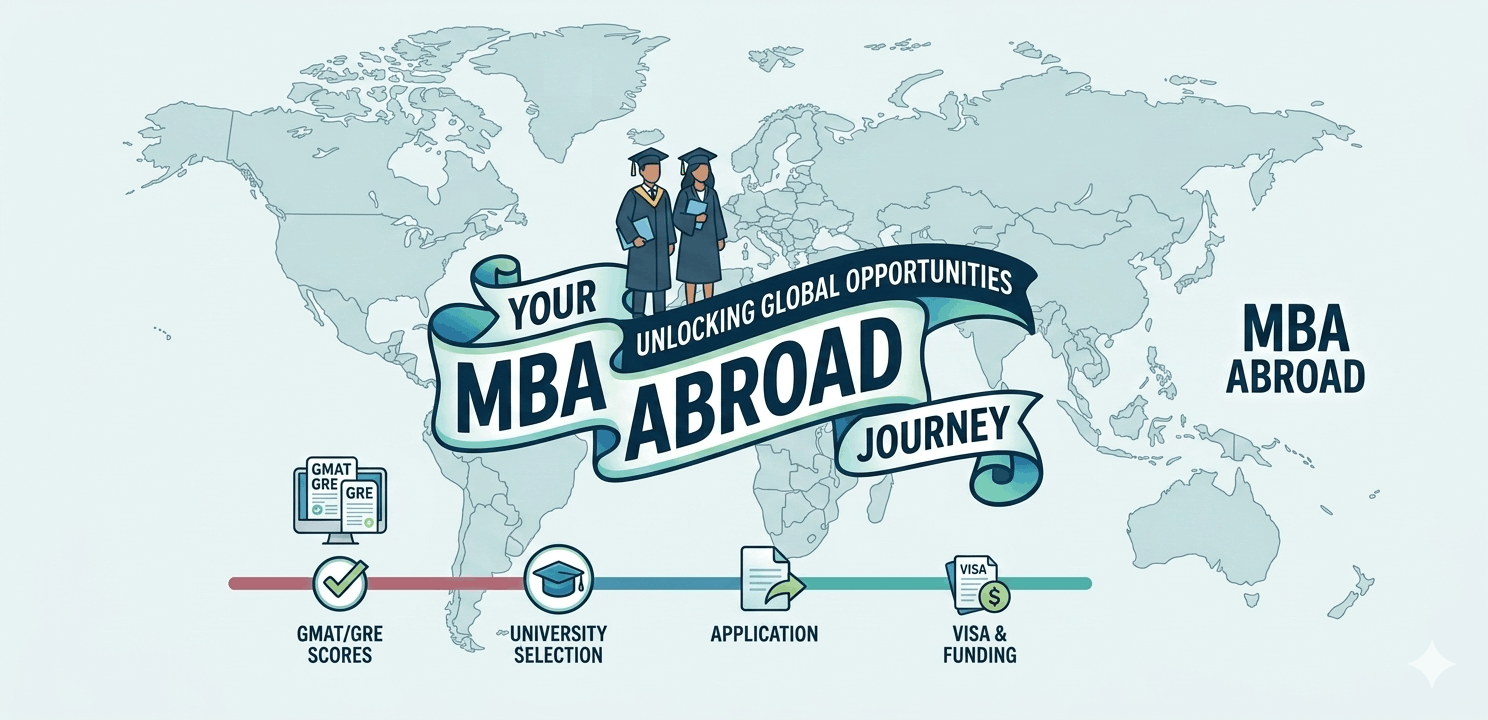
Here is a step-by-step roadmap for navigating the application timeline:
Step 1: Shortlist Target Business Schools: Evaluate programmes based on duration (10–17 months), cost, location, career specialisations, and target recruiters.
Step 2: Prepare for GMAT/GRE & Language Exams: Take necessary standardized tests early to allow time for retakes if higher scores are required.
Step 3: Build Resume and Draft Essays: Tailor your professional resume and draft school-specific essays reflecting post-MBA objectives.
Step 4: Secure Professional LORs: Request letters of recommendation from current or past supervisors well ahead of deadlines.
Step 5: Submit Online Application: Complete university application forms, upload certified transcripts, and pay application fees.
Step 6: Participate in Admission Interviews: Invited candidates complete video assessments or live interviews with admissions committee members or alumni.
Step 7: Accept Admission & Secure Scholarships: Confirm your acceptance seat, pay the deposit fee, and apply for merit scholarships.
Step 8: Apply for Student Pass (STP): Initiate Student Pass formalities via the ICA SOLAR System prior to arrival in Singapore.
Cost of Studying for MBA in Singapore
Understanding the total MBA in Singapore Cost requires accounting for both total tuition fees and living expenses. Tuition costs vary based on whether you attend a public autonomous university, an international branch campus, or a private institution.
Tuition Cost Breakdown:
Business School Tier | Approx. Total Program Tuition (SGD) | Approx. Total Program Tuition (INR) |
Affordable / Private B-Schools | SGD 42,000–55,000 | INR 26.2L–34.3L |
Mid-Tier & Global Campuses | SGD 55,000–85,000 | INR 34.3L–53.1L |
Top Autonomous Universities (NUS, NTU, SMU) | SGD 82,000–100,000 | INR 51.2L–62.5L |
Elite Global Schools (INSEAD) | SGD 160,000+ | INR 1.00 Cr+ |
Cost of Living for MBA in Singapore
The average monthly Cost of Studying for MBA in Singapore in terms of living expenditure ranges between SGD 1,500 and SGD 3,000 (INR 93,000–1.87 lakh). Accommodation forms the largest variable expense.
Expense Category | Monthly Estimated Cost (SGD) | Monthly Estimated Cost (INR) |
Accommodation (Shared Flat / HDB / Condo) | SGD 800–1,800 | INR 50,000–1.12 L |
Food & Groceries (Hawker Centers / Cooking) | SGD 400–700 | INR 25,000–43,700 |
Public Transportation (MRT & Bus) | SGD 100–180 | INR 6,250–11,250 |
Utilities & Internet | SGD 80–150 | INR 5,000–9,375 |
Personal & Miscellaneous Expenses | SGD 150–300 | INR 9,375–18,750 |
Combining tuition and living expenses, the total budget for an MBA program in Singapore ranges between INR 45 lakh and INR 1.15 crore overall.
Scholarships for MBA in Singapore
To manage overall study expenses, international candidates can apply for various merit-based MBA Scholarships in Singapore offered directly by universities, governmental bodies, and corporate sponsors.
Below are the Top Scholarships for MBA in Singapore:
Scholarship Name | Eligibility Criteria | Coverage & Benefits |
NUS MBA ASEAN & International Scholarships | Awarded based on academic merit, GMAT score, and leadership qualities | Partial to full tuition coverage |
Nanyang Fellows Scholarship (NTU) | High-performing professionals with outstanding managerial track record | Financial grant towards MBA tuition fees |
SMU Lee Kong Chian MBA Scholarship | Exceptional academic record and demonstrated leadership potential | Up to 50% tuition fee waiver |
INSEAD Asian Business Fellowships | Asian nationals demonstrating strong business acumen and leadership | Partial tuition fee support |
ADB - Japan Scholarship Program | Candidates from ADB borrowing member countries admitted to NUS/NTU | Full tuition fee, living stipend, housing allowance, and airfare |
Career Opportunities After MBA in Singapore
Singapore serves as the Asian headquarters for thousands of global enterprises, providing high post-MBA placement rates and competitive compensation packages. MBA Salary in Singapore remains competitive across industries, as the country serves as the Asian headquarters for thousands of multinational companies
Graduates securing a full-time job offer with a salary meeting official criteria can transition to an employer-sponsored Employment Pass (EP) without restrictive quota lotteries.
Top MBA Jobs in Singapore:
Job Role | Average Annual Salary (SGD) | Average Annual Salary (INR) |
Investment Banker | SGD 120,000–200,000 | INR 75.0 L–1.25 Cr |
Management / Strategy Consultant | SGD 90,000–130,000 | INR 56.2 L–81.2 L |
Product Manager (Tech) | SGD 85,000–110,000 | INR 53.1 L–68.7 L |
Corporate Finance Manager | SGD 80,000–115,000 | INR 50.0 L–71.8 L |
Marketing / Brand Manager | SGD 70,000–95,000 | INR 43.7 L–59.3 L |
Operations / Supply Chain Manager | SGD 65,000–90,000 | INR 40.6 L–56.2 L |
Source: Glassdoor
Author's POV
An MBA in Singapore represents a strategic investment for professionals aiming for regional or global business leadership. The combination of short course durations (10 to 17 months), exposure to top-tier multinational corporations, and proximity to emerging Asian markets generates a compelling return on investment.
While top-ranked MBA programs at universities like INSEAD, NUS, and NTU have higher tuition fees, many graduates recover this investment through better salaries, strong career growth, and valuable professional networks. However, prestige alone should not drive your decision; choosing a program whose industry specialization, career center connections, and class profile align with your career vision ensures the best long-term outcomes.
Frequently Asked Questions
Tuition fees for a full-time MBA in Singapore generally range from SGD 82,000 to SGD 100,000 (INR 51 Lakhs to INR 62 Lakhs) at top public universities like NUS, NTU, and SMU, while premier global campuses like INSEAD cost around SGD 163,000 (INR 1.02 Crore). Additionally, living expenses like housing, food, and transit average SGD 1,500 to SGD 2,800 monthly (INR 93,000 to INR 1.75 Lakhs).
Yes, pursuing an MBA in Singapore is a strategic choice for professionals seeking fast-track career growth in Asia. The country serves as a major financial and tech hub, housing global headquarters like Google, Meta, and DBS. Short 12-to-15-month program formats, high post-graduation employment rates, and bonus COMPASS points toward Employment Passes make it an exceptionally high-ROI destination for international students.
The National University of Singapore (NUS) and INSEAD (Asia Campus) consistently rank as the top choices. INSEAD is ideal for candidates seeking a top-tier global network and consulting focus, while NUS excels in regional leadership, Asia-centric business strategy, and technology integration. Nanyang Technological University (NTU) and Singapore Management University (SMU) are also premier choices for finance, analytics, and innovation tracks.
Graduates from top Singaporean business schools command impressive starting salaries, typically averaging between SGD 130,000 and SGD 160,000 annually (approx. INR 80 Lakhs to INR 1.0 Crore+). Leading sectors like management consulting, fintech, investment banking, and technology offer the highest compensation packages, often supplemented by sign-on bonuses ranging from SGD 15,000 to SGD 30,000 (INR 9.3 Lakhs to INR 18.7 Lakhs) depending on prior experience.
The leading institutions include INSEAD (Asia Campus), National University of Singapore (NUS), Nanyang Technological University (NTU), and Singapore Management University (SMU).
Full-time international students enrolled in autonomous universities like NUS, NTU, or SMU are permitted to work up to 16 hours per week during term time and full-time during official vacation periods without a separate work permit. However, if you are enrolled in certain private institutions or foreign branch campuses, part-time work may be strictly prohibited under Student’s Pass regulations. Given the fast-paced, 12-to-15-month intensity of most Singapore MBA curricula, most candidates prefer focusing on consulting projects and internship modules instead of external part-time jobs.
Unlike countries with automatic multi-year post-study work visas, Singapore requires foreign graduates to transition onto an official work pass sponsored by an employer. Graduating from an accredited local university grants you eligibility for a 1-year Short-Term Visit Pass (STVP) to remain in Singapore and job hunt full-time.
Singapore evaluates Employment Pass (EP) applications using the Complementarity Assessment Framework (COMPASS), where candidates must earn at least 40 points across criteria like salary and qualifications. Holding an MBA from top-tier institutions like NUS, NTU, SMU, or INSEAD automatically awards you 20 points under the "Qualifications" criterion (Criterion 2). This top-tier academic weighting significantly boosts your overall score, making it easier for sponsoring employers to secure your EP approval.
Yes, several business schools in Singapore offer GMAT/GRE waivers under specific conditions, though requirements vary by institution. Applicants with 7 to 10+ years of progressive managerial experience, strong quantitative backgrounds, or professional certifications (like CFA or CPA) can request a formal waiver during the application process. However, for top-tier competitive programs at INSEAD or NUS, submitting a strong GMAT or GRE score remains highly recommended to boost merit scholarship consideration.
Most full-time MBA graduates from top Singaporean institutions recover their financial investment within 2 to 3.5 years post-graduation. Because most Singapore MBAs are completed in just 12 to 15 months, you lose less opportunity cost compared to traditional two-year global programs. Furthermore, post-MBA salaries in Singapore typically range from SGD 130,000 to SGD 160,000+ per year (approx. INR 87 lakh–1.07 crore+), excluding performance bonuses.
While an MBA does not guarantee automatic Permanent Residency, it substantially strengthens your candidate profile for a PR application. Securing an Employment Pass (EP) post-graduation, working in a critical-skills sector (such as tech, finance, or healthcare), and demonstrating economic integration in Singapore for 2 to 3 years establishes a solid foundation to apply for PR under the Professionals, Technical Personnel, and Skilled Workers (PTS) scheme.