Masters in Finland
Table of Contents
- Popular specializations for Masters in Finland
- Admission Requirements for Masters in Finland
- Intakes for Masters in Finland
- How to Apply for Masters in Finland
- Cost of Studying Masters in Finland
- Scholarships for Masters in Finland
- Visa Requirements for Masters in Finland
- Careers After Masters in Finland
- Post-Study Work Opportunities
- Author's Final Thoughts
Finland offers a different kind of study-abroad experience: research-focused universities, practical Universities of Applied Sciences (UAS), modern campuses and a strong emphasis on innovation and student wellbeing. Finland has 13 universities and 22 Universities of Applied Sciences, together offering more than 600 English-taught bachelor's and master's programmes across fields including business, technology, engineering, ICT and natural sciences.
Around 28,800 international students applied for English-taught bachelor's and master's programmes starting in autumn 2026, showing the growing interest in Finland among international applicants. India was among the countries contributing the highest number of applications.
Master's degree at a Finnish university takes 2 years, while UAS Master's programmes can take around 1–1.5 years. UAS programmes also require two years of relevant work experience, making them particularly relevant for working professionals.
Non-EU/EEA students generally pay €8,000–€20,000 (Approx. ₹8–20 lakh) per year for English-taught Master's programmes. The actual fee depends on the university and programme, while scholarships and tuition waivers may reduce the amount payable.
Finland is not a completely free Master's destination for Indian students. University scholarships can reduce or sometimes cover tuition fees, but students should plan separately for living expenses because scholarships generally do not cover these costs.
Living costs are approximately €900–€1,200 (Approx. ₹90,000–₹1.2 lakh) per month, depending on the city and lifestyle. Accommodation, food and transportation make up a significant part of a student's monthly budget.
The main application route is Studyinfo.fi, Finland's official higher-education application portal. Many programmes for the September intake participate in the January joint application, although some universities and programmes have separate application rounds.
Finland can be particularly interesting for students who want a balance between academics and lifestyle. Modern learning environments, student communities, extensive libraries and Finland's focus on wellbeing are part of the country's higher-education experience.
In this guide, we'll cover the top universities in Finland for Master's, popular specializations, admission requirements, intakes, application process, tuition and living costs, scholarships, visa requirements, work opportunities and career prospects for international students.p Universities for Masters in Finland
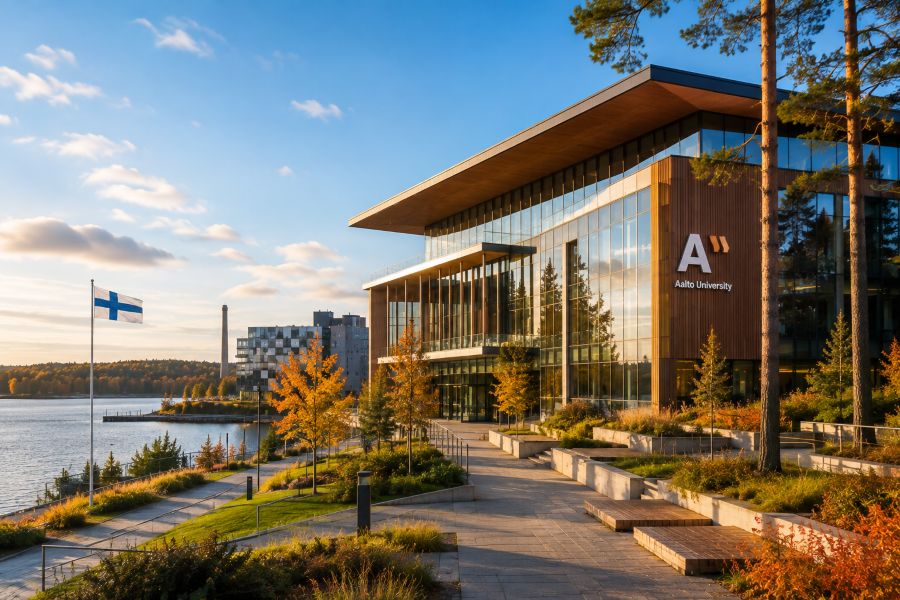
Study in in Finland for masters is inclusive of research, innovation and practical learning, with institutions offering programmes in English for international students. Aalto University is strong in technology, business and design, where as the University of Helsinki offers a broad range of multidisciplinary programmes. Tampere, Turku and Oulu are also important choices for students seeking specialized master's education.
University | Study Format |
Aalto University | Research + industry-focused |
University of Helsinki | Research-oriented |
Tampere University | Research + practical |
University of Turku | Research-oriented |
University of Oulu | Research + industry-focused |
Aalto University currently offers more than 90 English-taught master's programmes across arts and design, business and economics, and technology and engineering. The University of Helsinki offers more than 30 multidisciplinary English-taught international master's programmes, that can be completed over two years and 120 ECTS.
Popular specializations for Masters in Finland
Finland's education system is closely connected with technology, innovation, sustainability and research, creating strong options for students with different academic backgrounds. Popular masters courses in Finland include computer science, data science, engineering, business analytics, environmental sciences and health-related disciplines.
Specialization | Popular Master's Programmes |
Computer Science & IT | Computer Science, Artificial Intelligence, Software Engineering, Cybersecurity |
Data & Analytics | Data Science, Business Analytics, Machine Learning |
Engineering | Electrical Engineering, Mechanical Engineering, Automation, Communications Engineering |
Business | Finance, International Business, Marketing, Business Analytics |
Life Sciences | Biotechnology, Molecular Biology, Biomedical Sciences |
Environmental Studies | Sustainability, Environmental Sciences, Renewable Energy |
Health Sciences | Public Health, Health Technology, Biomedical Sciences |
Admission Requirements for Masters in Finland
Admission requirements for Masters in Finland are determined by the individual university and programme. Generally, applicants are required to submit relevant bachelor's degree and must demonstrate their previous studies for required academic background. English-language programmes also have specific language requirements, while UAS master's programmes have an additional professional experience requirement.
Requirement | Details |
Bachelor's Degree | A recognized bachelor's degree relevant to the chosen master's programme |
Academic Background | Previous studies must include the subjects or credits required by the programme |
Work Experience | Generally required for master's programmes at universities of applied sciences |
English Proficiency | IELTS 6.5 or equivalent may be accepted, depending on programme requirements |
GRE/GMAT | Required only for selected programmes, if specified |
Documents | Degree certificate, transcripts, passport, English test score, CV and other programme-specific documents |
Additional Requirements | Some programmes may require an entrance exam, interview, portfolio, motivation letter or other assessment |
The exact eligibility criteria should always be checked on Studyinfo.fi and the university's programme page because requirements differ between programmes.
Intakes for Masters in Finland
Finland's main admission cycle for international master's students is primarily the autumn academic intake. The national joint application for programmes beginning in September, which is held in January, although some universities and programmes use separate application periods. Students should therefore check the exact deadline rather than relying on a single national date.
Autumn Intake: The main admission cycle for masters programmes in Finland. The joint application is arranged in January for studies beginning in September.
For example, the University of Helsinki's autumn 2027 application period is scheduled for 5–19 January 2027, while Tampere University's autumn 2027 English-taught master's application period is scheduled from 14 December 2026 to 7 January 2027.
Separate Application Rounds
Some universities conduct separate or programme-specific application rounds, including rolling admissions in certain cases. Therefore, students should check Studyinfo.fi and the university website for the exact application window of their chosen programme.
Need Help Choosing the Right Master's Programme in Finland? Visit Study Abroad Programs for personalised guidance on your journey towards studying in Finland with expert support. |
How to Apply for Masters in Finland
The application process for master degree in Finland for international students is largely online and begins with selecting a suitable programme through Studyinfo.fi. Applicants should always compare eligibility requirements, tuition fees, scholarships, deadlines and required documents before submitting their application.
Step | What to Do |
1. Shortlist Programmes | Compare universities, specializations, tuition fees, career outcomes and admission requirements |
2. Check Eligibility | Confirm your bachelor's degree, academic background, work experience and language requirements |
3. Prepare Documents | Arrange transcripts, degree certificate, passport, CV, English test score and programme-specific documents |
4. Check Scholarships | Review university scholarships and tuition-fee waivers before submitting your application |
5. Apply Online | Submit the application through Studyinfo.fi or the programme's specified application route |
6. Complete Selection Requirements | Attend an interview, entrance exam or submit a portfolio if required |
7. Accept the Offer | Confirm your study place within the deadline mentioned in your admission decision |
8. Apply for Residence Permit | After admission, arrange financial proof and insurance and submit your residence permit application |
Students can apply to up to six degree programmes in one joint application, while separate applications may have different rules and deadlines.
Cost of Studying Masters in Finland
The cost of studying in Finland depends mainly on university, programme, city and lifestyle. For non-EU/EEA students enrolled in English-taught master's programmes, tuition is the largest expense. Finland's official study portal estimates tuition fees at €8,000–€20,000 (Approx. ₹8–20 lakh) per year,.
Institution/Programme | Approximate Annual Tuition Fee |
English-taught Master's Programmes | €8,000–€20,000 (Approx. ₹8–20 lakh) |
Student Union Fee | Approximately €50–€70 (Approx. ₹5,000–₹7,000) per year at universities |
Source: Study in Finland
Applicants should check the individual programme before calculating their total budget.
Living Expenses
Living in Finland is expensive than in many European study destinations. Helsinki and the surrounding metropolitan areas are the most expensive. Students should budget for accommodation, food, transportation, healthcare-related expenses, phone and internet services and personal spending. The official Study in Finland guidance recommends approximately €900–€1,200 (Approx. ₹90,000–₹1.2 lakh) per month, depending on location and lifestyle.
Expense | Approximate Monthly Cost |
Accommodation | €450–€800 (Approx. ₹45,000–₹80,000) |
Food & Groceries | €200–€300 (Approx. ₹20,000–₹30,000) |
Transportation | €40–€80 (Approx. ₹4,000–₹8,000) |
Utilities & Internet | €50–€100 (Approx. ₹5,000–₹10,000) |
Personal Expenses | €100–€200 (Approx. ₹10,000–₹20,000) |
Total | Approximately €900–€1,200 (Approx. ₹90,000–₹1.2 lakh) |
Source: Numbeo
The Finnish Student Health Service fee is currently around €70 (Approx. ₹7,000) per year for students studying for bachelor's or master's degrees.
Scholarships for Masters in Finland
There are no general Finnish government scholarships for masters degree students. Instead, individual universities offer scholarships and tuition-fee waivers, which are competitive and generally do not cover living costs.
Scholarship Type | Eligibility | Typical Benefit |
University Tuition Waiver | Strong applicants admitted to eligible programmes | Partial or full tuition-fee waiver, depending on university |
Merit-Based Scholarship | Academic excellence and strong application profile | Tuition reduction or waiver |
Programme-Specific Scholarship | Applicants meeting programme-specific criteria | Varies by programme |
Progress-Based Scholarship | Existing students meeting academic or credit requirements | Tuition reduction in selected universities |
Students should apply for scholarships at the same time as admission whenever the university requires it.
Visa Requirements for Masters in Finland
Indian students who are not EU/EEA citizens and plan to pursue masters degree in Finland for more than 90 days need a student residence permit rather than a short-term visa. The application can be submitted after receiving an admission offer and students must demonstrate sufficient funds and valid insurance.
Requirement | Details |
Admission Letter | Confirmation of admission to a Finnish higher education institution |
Financial Proof | At least €800 (Approx. ₹80,000) per month, or €9,600 (Approx. ₹9.6 lakh) for one year |
Health Insurance | Valid private insurance meeting Finnish requirements |
Passport | Valid passport and required identification documents |
Tuition Proof | Evidence of paid tuition or scholarship, where applicable |
Bank Statement | Financial documentation, including required bank statements |
Application | Submit through the Enter Finland online service |
Residence Permit Fee | €600 (Approx. ₹60,000) for the first electronic study residence permit in 2026 |
The financial requirement is separate from tuition fees. If tuition has not yet been paid, students may also need to demonstrate that they have sufficient funds to cover the tuition fee in addition to their living costs.
Careers After Masters in Finland
Masters degree in Finland can help graduates access roles that require advanced technical, analytical or managerial skills. However, students should understand that Finnish-language skills can improve access to a wider range of jobs, particularly outside internationally oriented companies.
Popular Job Roles and Salary
Job Role | Approximate Annual Salary | Relevant Industries |
Software Engineer | €45,000–€65,000 (Approx. ₹45–65 lakh) | Technology, Software, Telecom |
Data Scientist | €43,000–€55,000 (Approx. ₹43–55 lakh) | Technology, Finance, Healthcare |
Business Analyst | €45,000–€60,000 (Approx. ₹45–60 lakh) | Consulting, Finance, Technology |
Project Manager | €50,000–€70,000 (Approx. ₹50–70 lakh) | Engineering, Technology, Manufacturing |
Product Manager | €55,000–€75,000 (Approx. ₹55–75 lakh) | Technology, SaaS, Consumer Products |
Financial Analyst | €45,000–€65,000 (Approx. ₹45–65 lakh) | Banking, Finance, Consulting |
Source: Glassdoor
Salary varies considerably by experience, employer, location and specialization.
Post-Study Work Opportunities
After completing a Finnish degree, international graduates can apply for a two-year residence permit to look for work or start a business. Students who secure employment can then move to an appropriate work-based residence permit.
Author's Final Thoughts
Masters in Finland is a strong choice for Indian students who value high-quality education, practical learning, research opportunities and a well-organized European study environment. However, Finland is not a low-cost destination: non-EU/EEA students should carefully plan for tuition fees and living expenses and should not depend on part-time work to fund their education. Scholarships can reduce tuition costs, but they are competitive and usually do not cover living expenses.
Choosing the right university, specialization and career pathway is therefore essential for getting good value from your degree. Thus, career planning is an important part of choosing master's programme.
Frequently Asked Questions
A master's degree in Finland is generally not free for non-EU/EEA students enrolled in English-taught programmes. Tuition fees typically range from €8,000–€20,000 (Approx. ₹8–20 lakh) per year. However, many Finnish universities offer scholarships or tuition-fee waivers based on academic merit, which can significantly reduce the overall cost.
Yes, Finland is a strong destination for master's degrees, particularly for students interested in technology, engineering, data science, business, sustainability, healthcare, and research. Finnish universities combine research with practical learning and offer many English-taught programmes. However, students should consider the relatively high living costs and competitive job market before choosing Finland.
A master's degree does not automatically lead to permanent residence in Finland. Graduates can first use the available post-study residence route to look for employment or start a business. Permanent residence depends on meeting the applicable residence, employment, income, language and other requirements. Therefore, students should view PR as a longer-term pathway rather than a guaranteed benefit of graduation.
IELTS is not universally mandatory for every master's programme in Finland. English-taught programmes generally require applicants to demonstrate English proficiency, but the accepted methods vary by university. Some institutions may accept TOEFL or other approved tests, while certain applicants may qualify for an exemption based on their previous education. Always check the specific programme's language requirements before applying.
Finland can be a good option for Indian students seeking research-focused education, technology-oriented programmes, a safe environment and international exposure. It is particularly attractive for students interested in technology, engineering, sustainability, business, healthcare and data-related fields. Students should, however, carefully consider tuition and living costs before applying.
Yes. Finland has many English-taught master's programmes, including programmes at universities such as Aalto University and the University of Helsinki. Finnish or Swedish is generally not required for admission to an English-taught programme, although learning a local language can improve employment opportunities after graduation.
No. Finland does not have a general government scholarship programme that fully funds bachelor's or master's studies. Instead, individual universities may offer scholarships or tuition-fee waivers to international students. These scholarships are competitive and generally do not cover living expenses.
The better option depends on your career goal. Research universities are more suitable for students interested in academic research, advanced theory or doctoral studies. Universities of applied sciences focus more strongly on professional skills and industry applications. UAS master's programmes also generally require relevant work experience.
Yes. Through the national joint application, applicants can apply to up to six degree programmes in one application. Some programmes use separate application routes, so students should check the individual programme's application rules and deadlines before submitting their choices.
Job opportunities depend heavily on your specialization, experience, language skills and networking. Technology, engineering, data, healthcare and other specialized fields can offer opportunities, but international students should not assume that graduation automatically leads to employment. Finnish or Swedish language skills can broaden the range of jobs available.
Yes. After completing a degree in Finland, international graduates can apply for a two-year residence permit to look for work or start a business. If they secure suitable employment, they can transition to a work-based residence permit.