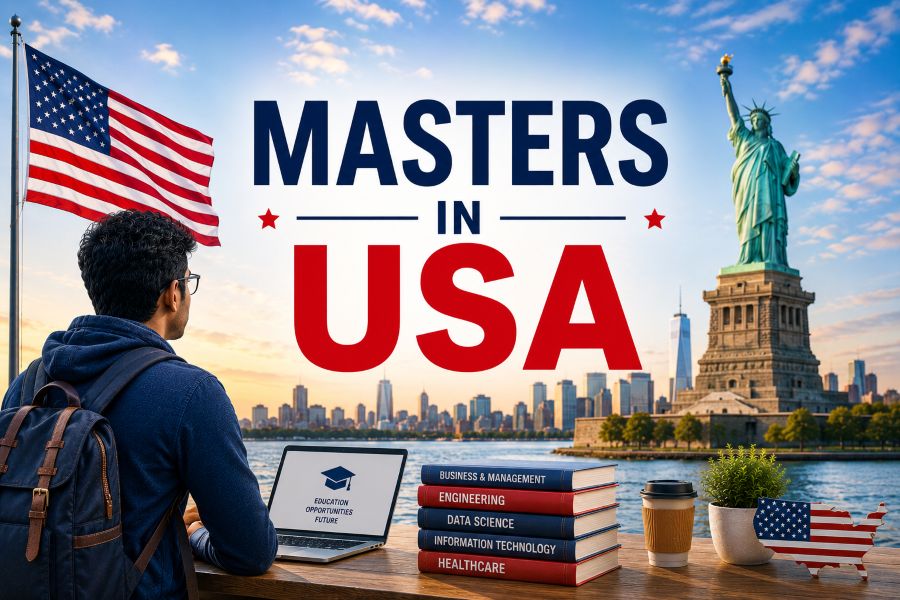
Masters in USA
Table of Contents
- Types of Masters in USA
- Popular Fields Masters in USA
- Best Universities for Masters in USA
- Admission Requirements for Masters in USA
- Intake Windows for Masters in USA
- Cost of Studying Masters in USA
- Scholarships for Masters in USA
- How to Apply for Masters in USA
- Careers after Masters in USA
- OPT & STEM OPT
- Author's Final Thought
USA attracts millions of international students. Whether you are interested in technology, engineering, business, healthcare, finance or research, pursuing Masters in USA provides access to world-class faculty, modern infrastructure and one of the world's most innovative economies.
USA is world's most preferred destination for master's education, offering over 2,000 universities and thousands of specialized graduate programs. Top institutions like MIT, Stanford, Harvard, UC Berkeley, and Caltech consistently rank among the world's best universities.
Most master's programs take 1–2 years, with accelerated one-year options available in selected disciplines. Tuition fees ranges from USD 20,000–90,000 per year (Approx. ₹17–77 lakh) depending on the university and programme.
STEM graduates benefit from up to 36 months of Optional Practical Training (OPT), making the USA one of the best countries for post-study employment. As they also secure high-paying roles in technology, healthcare, engineering, finance, consulting, research and management.
Scholarships, assistantships, and research funding significantly reduce study costs for qualified international students.
This guide covers everything Indian students need to know about pursuing Masters in USA, including programme types, top universities, admission requirements, costs, scholarships, application process, careers, salaries and post-study opportunities.
Key Highlights
Particular | Details |
Course Duration | 1–2 Years |
Popular Degrees | MS, MA, MEng, MBA, Professional Master's |
Tuition Fees | USD 20,000–90,000/year (Approx. ₹17–77 lakh) |
Living Expenses | USD 12,000–25,000/year (Approx. ₹10–21 lakh) |
Intakes | Fall, Spring, Summer |
Popular Study Cities | Boston, New York, Chicago, Los Angeles, San Francisco |
Post-Study Work | OPT (12 months) + STEM OPT Extension (24 months) |
Average Graduate Salary | USD 80,000–140,000/year (Approx. ₹68 lakh–1.2 crore) |
Types of Masters in USA
American universities offer several types of master's programs build to suit different academic backgrounds, career objectives and professional aspirations. Students can choose research-focused degrees, professional qualifications or industry-oriented programs depending on their goals.
Below are the most common master's degree options available in USA:
Degree Type | Duration | Ideal For |
Master of Science (MS) | 1.5–2 Years | STEM, Engineering, Computer Science, Healthcare |
Master of Arts (MA) | 1–2 Years | Humanities, Social Sciences, Education |
Master of Engineering (MEng) | 1–2 Years | Professional Engineering Careers |
Master of Business Administration (MBA) | 1–2 Years | Business Leadership & Management |
Professional Master's | 1–2 Years | Specialized industry-focused careers |
Most universities also provide two academic pathways:
Programme Type | Description |
Thesis-Based | Includes extensive research under faculty supervision and preparation of a dissertation. Suitable for research careers or doctoral studies. |
Non-Thesis | Coursework-intensive programmes focused on practical industry skills with capstone projects instead of dissertations. |
Popular Fields Masters in USA
USA offers thousands of graduate programs across almost every discipline. However, certain fields consistently attract international students because of their strong employment prospects, research opportunities, and industry demand.
These are popular masters courses in USA chosen by Indian students.
Field | Popular Specialisations |
Computer Science | Artificial Intelligence, Machine Learning, Cybersecurity, Cloud Computing |
Data Science | Business Analytics, Big Data, Predictive Analytics |
Engineering | Mechanical, Civil, Electrical, Software, Robotics |
Business | MBA, Finance, Marketing, Supply Chain |
Healthcare | Public Health, Healthcare Administration, Biomedical Sciences |
Finance | Investment Banking, FinTech, Financial Analytics |
Information Technology | Information Systems, Digital Transformation |
Biotechnology | Molecular Biology, Genetics, Pharmaceutical Sciences |
Environmental Science | Sustainability, Climate Science |
Education | Educational Leadership, Curriculum Development |
These programs qualify for STEM designation, enabling graduates to benefit from longer post-study work opportunities.
Best Universities for Masters in USA
USA hosts world's highest-ranked universities, offering exceptional graduate education, research facilities and industry collaborations. Choosing the right institution depends on programme reputation, faculty expertise, location, tuition fees, research opportunities, and career outcomes.
Below are some of the leading universities in USA for masters.
University | QS University Ranking'27 |
Massachusetts Institute of Technology (MIT) | 1 |
Stanford University | 2 |
Harvard University | 5 |
California Institute of Technology (Caltech) | 7 |
Cornell University | 16 |
University of Pennsylvania | 15 |
University of California, Berkeley | 20 |
Columbia University | 43 |
University of Michigan | 51 |
Carnegie Mellon University | 55 |
Admission Requirements for Masters in USA
Admission to Masters in USA programme is holistic. Universities evaluate academic performance, entrance test scores, language proficiency, research potential, extracurricular achievements and overall suitability for graduate studies.
Understanding early helps students prepare competitive applications and meet university deadlines effectively.
Most universities require the following eligibility criteria.
Requirement | Requirement |
Academic Qualification | Recognized bachelor's degree (3 or 4 years depending on university) |
Minimum GPA | Around 3.0/4.0 (Approx. 70–80%) |
IELTS | 6.5–7.0 |
TOEFL iBT | 80–100 |
GRE | Required for many STEM programmes (varies by university) |
GMAT | Required mainly for MBA programmes |
SOP | Required |
Letters of Recommendation | 2–3 |
Resume/CV | Required |
Passport | Required |
Many universities have adopted test-optional policies, although competitive GRE or GMAT scores continue to strengthen applications for highly selective programs.
Intake Windows for Masters in USA
US universities generally offer multiple admission cycles throughout the year, providing flexibility for international applicants. However, Fall intake is most popular because it offers the widest selection of programs, scholarships, research assistantships and internship opportunities.
Below are the primary admission intakes for Masters in USA.
Intake | Application Period | Classes Begin |
Fall Intake | October – February | August/September |
Spring Intake | July – October | January |
Summer Intake | January – March | May |
Tip: Students targeting Fall 2027 should ideally begin planning by August–September 2026 to maximize scholarship opportunities and meet early application deadlines.
Cost of Studying Masters in USA
Masters in USA cost depends on the university type, programme, city and duration. Besides tuition fees, students should budget for accommodation, health insurance, food, transportation, books and miscellaneous expenses.
Tuition Fees
Tuition fees vary significantly across public and private universities.
University Type | Annual Tuition Fee |
Public Universities | USD 20,000–40,000 (Approx. ₹17–34 lakh) |
Private Universities | USD 30,000–90,000+ (Approx. ₹26–77 lakh) |
Living Expenses
Expense | Estimated Annual Cost |
Accommodation | USD 8,000–15,000 (Approx. ₹6.8–12.8 lakh) |
Food | USD 3,000–6,000 (Approx. ₹2.6–5.1 lakh) |
Transportation | USD 1,000–2,000 (Approx. ₹85,000–1.7 lakh) |
Health Insurance | USD 1,000–3,000 (Approx. ₹85,000–2.6 lakh) |
Books & Supplies | USD 800–1,500 (Approx. ₹68,000–1.3 lakh) |
Miscellaneous | USD 2,000–4,000 (Approx. ₹1.7–3.4 lakh) |
Overall living expenses generally range between USD 12,000–25,000 per year (Approx. ₹10–21 lakh).
Scholarships for Masters in USA
Many universities and external organizations offer scholarships, assistantships, fellowships and tuition waivers that significantly reduce the financial burden of pursuing a Masters in USA.
Popular scholarship options include:
Scholarship | Offered By | Benefits |
Fulbright-Nehru Master's Fellowship | USIEF | Tuition, living expenses, airfare |
Inlaks Shivdasani Foundation Scholarship | Inlaks Foundation | Partial funding |
Tata Scholarship | Cornell University | Need-based financial assistance |
Stanford Graduate Fellowships | Stanford University | Merit-based funding |
Harvard Graduate School Aid | Harvard University | Need-based scholarships |
MIT Fellowships | MIT | Research and academic funding |
Graduate Research Assistantships (RA) | Universities | Tuition waiver + stipend |
Teaching Assistantships (TA) | Universities | Tuition waiver + stipend |
Many graduate students also receive funding through departmental assistantships, which include monthly stipends and partial or full tuition waivers.
How to Apply for Masters in USA
The application process for Masters in USA involves careful planning, timely documentation and meeting university-specific deadlines. Since admission decisions are holistic, students should prepare every component of their application thoroughly.
Follow the steps below to successfully apply for a master's programme in USA:
Step | What You Need to Do | Key Details |
1. Shortlist Universities | Research universities and programmes | Compare curriculum, rankings, tuition fees, location, faculty, research opportunities, and career outcomes. |
2. Check Eligibility | Review programme-specific requirements | Verify minimum GPA, prerequisite subjects, work experience (if applicable), and English language requirements. |
3. Prepare Standardized Tests | Take required entrance exams | Complete GRE or GMAT (if required), along with IELTS or TOEFL for English proficiency. |
4. Gather Application Documents | Prepare supporting documents | Arrange academic transcripts, degree certificates, Statement of Purpose (SOP), Letters of Recommendation (LORs), resume/CV, passport, and test score reports. |
5. Submit Online Applications | Apply through university portals | Complete the online application, upload documents, and pay the application fee before the deadline. |
6. Attend Interview (If Required) | Participate in admission interview | Some universities conduct virtual interviews to assess academic goals, communication skills, and overall suitability. |
7. Receive Admission Offer | Review admission decision | Successful applicants receive an offer letter outlining tuition deposits, enrolment requirements, and scholarship details (if awarded). |
8. Accept the Offer | Confirm your admission | Pay the enrolment or tuition deposit before the specified deadline to secure your seat. |
9. Apply for F-1 Student Visa | Begin visa application process | Obtain the Form I-20, pay the SEVIS fee, complete the DS-160 application, schedule the visa interview, and prepare financial documents. |
F-1 Student Visa Process
Once admitted, students apply for an F-1 Student Visa.
Requirement | Description |
Passport | Valid passport for the duration of your studies |
Form I-20 | Issued by your university after admission confirmation |
DS-160 Confirmation | Online non-immigrant visa application form |
SEVIS Fee Receipt | Mandatory fee payment confirmation |
Admission Letter | Official offer from the university |
Financial Proof | Bank statements, sponsor documents, scholarship letters, or education loan approval |
Academic Documents | Transcripts, degree certificates, and test scores |
Visa Interview | Attend the interview at the nearest US Embassy or Consulate |
Careers after Masters in USA
Graduates completing Masters in USA enjoy excellent career opportunities across technology, engineering, finance, healthcare, consulting, manufacturing, research and management sectors. Many employers actively recruit graduates from leading American universities because of their strong technical and analytical skills.
Average Salary after Masters in USA
Job Role | Average Annual Salary |
Software Engineer | USD 110,000–150,000 (Approx. ₹94 lakh–1.28 crore) |
Data Scientist | USD 115,000–160,000 (Approx. ₹98 lakh–1.37 crore) |
Business Analyst | USD 90,000–125,000 (Approx. ₹77 lakh–1.07 crore) |
Financial Analyst | USD 85,000–120,000 (Approx. ₹72 lakh–1.03 crore) |
Mechanical Engineer | USD 90,000–130,000 (Approx. ₹77 lakh–1.11 crore) |
Product Manager | USD 120,000–170,000 (Approx. ₹1.03–1.45 crore) |
Graduates frequently secure employment with:
Google
Microsoft
Amazon
Apple
Meta
Deloitte
EY
PwC
JPMorgan Chase
Goldman Sachs
Tesla
Intel
NVIDIA
IBM
Oracle
OPT & STEM OPT
One of the advantages of studying in USA is Optional Practical Training (OPT) programme. This extended work period allows graduates to gain valuable U.S. industry experience before pursuing long-term employment opportunities.
Standard OPT: 12 months
STEM OPT Extension: Additional 24 months
Total work authorization for eligible STEM graduates: 36 months
Author's Final Thought
Masters in USA is great for students seeking world-class education. American education system allows students to personalize their academic journey while building valuable industry connections through internships, research projects and campus recruitment.
For Indian students planning 2026–27 admissions, your key is to start preparing early. Focus on strengthening your academic profile, preparing competitive test scores, writing a compelling SOP and applying before scholarship deadlines.
Book a 1:1 counselling session for further guidance on your study abroad journey.
Frequently Asked Questions
Most master's programmes take between 1 and 2 years, although accelerated one-year programmes are available in selected fields such as business, analytics, and management.
Most universities prefer applicants with a minimum GPA of 3.0 out of 4.0 or its equivalent, though top-ranked institutions may expect higher academic performance.
Not always. Many universities have adopted test-optional policies, but strong GRE scores can improve admission chances for competitive STEM programmes.
Some universities accept recognized three-year bachelor's degrees, while others require a four-year degree or additional academic qualifications. Applicants should verify individual university requirements.
Tuition generally ranges from USD 20,000–90,000 per year, while annual living expenses usually range between USD 12,000–25,000, depending on the city and lifestyle.
Institutions such as MIT, Stanford University, Harvard University, UC Berkeley, Carnegie Mellon University, and the University of Michigan consistently rank among the best choices for graduate education.
Yes. Eligible students can work on campus during academic sessions and may qualify for authorized off-campus employment opportunities under applicable regulations.
Applicants typically need academic transcripts, degree certificates, SOP, LORs, resume, passport, language test scores, and GRE/GMAT scores where applicable.
Yes. Universities, government agencies, and private organizations offer merit-based scholarships, assistantships, fellowships, and tuition waivers for qualified applicants.
OPT allows international graduates to work in the USA after graduation. Eligible STEM graduates can extend their work authorisation to a total of 36 months.
Technology, Artificial Intelligence, Data Science, Engineering, Finance, Healthcare, Product Management, and Business Analytics are among the highest-paying fields for master's graduates in USA.