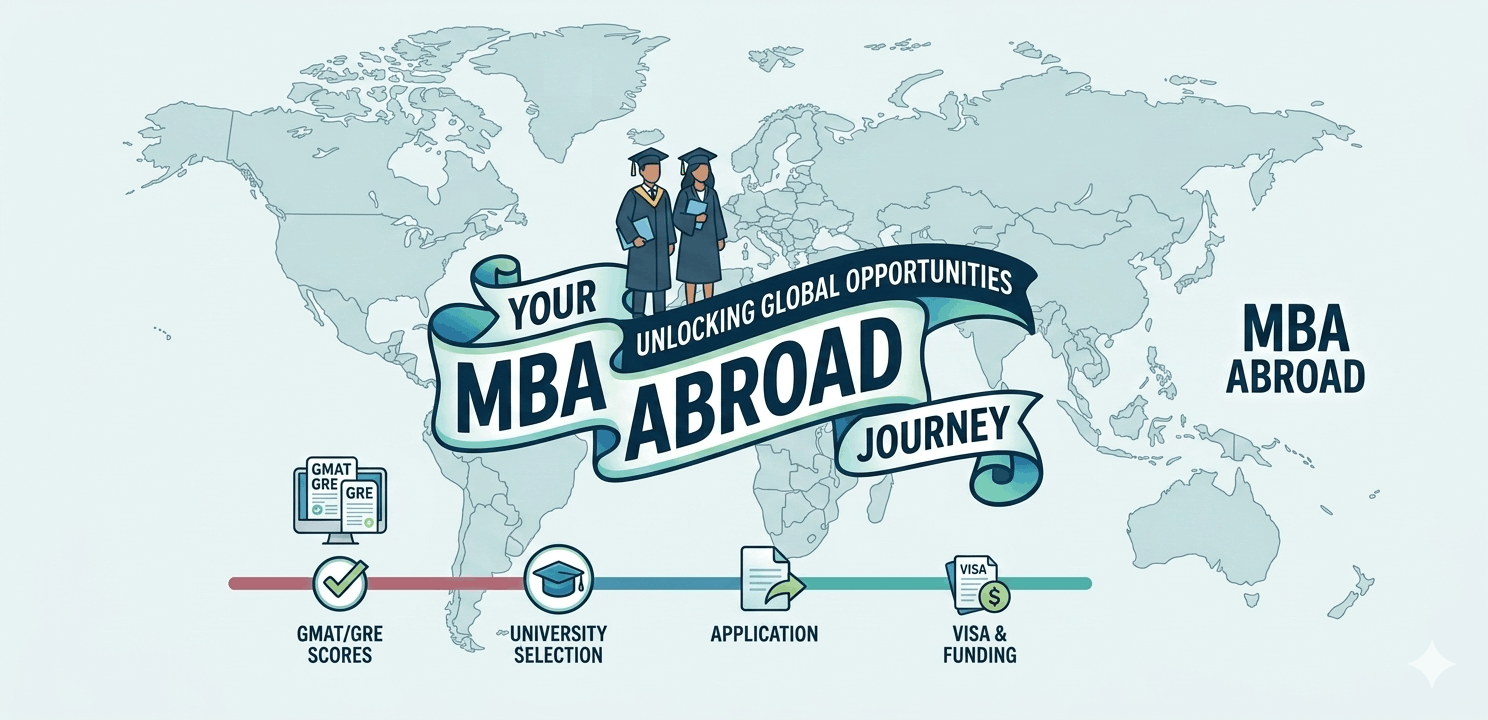

MBA Abroad
Table of Contents
- Top Universities for MBA Abroad
- Popular MBA Specialisations Abroad
- Eligibility and Admission Requirements for MBA Abroad
- Cost of Studying MBA Abroad
- Top Scholarships for MBA Abroad
- Student Visa Requirements for MBA Abroad
- Best Countries for MBA Abroad
- Job Opportunities After MBA Abroad
- How to Apply for MBA Abroad
- Conclusion
An MBA abroad offers global networking, elite curriculum, and international career mobility. Top programs typically require 2–5 years of work experience, competitive GMAT/GRE scores, and strong essays. Costs range widely from ₹40 L to ₹1.5+ Cr., but strong ROI is common through high starting salaries and post-study visas.
Top countries such as USA, UK, France, Canada, Germany, Australia, and Singapore offer MBA programs focused on leadership, finance, consulting, analytics, entrepreneurship, and strategy. An MBA abroad is not only about the degree; it is also about the network, exposure, and career.
The table below highlights the most important points students should know before planning an MBA abroad:-
Key Point | Details | Estimated Value |
Top Countries | USA, UK, Canada, Germany, Australia | Based on career goals |
Course Duration | Full-time MBA | 1–2 years |
MBA Abroad Fees | Depends on country and university | ≈ ₹25 lakh–₹1.6 Cr.+ |
Top Ranked School | Penn Wharton | QS Global MBA Rank 1 |
Common Exams | GMAT, GRE, IELTS, TOEFL | Varies by university |
Work Experience | Preferred by top MBA schools | 2–5 years |
Popular Specialisations | Finance, consulting, analytics, marketing | Career-focused options |
Post-Study Work Options | Depends on country | 12 months to 3 years |
Salary Scope | Depends on role and country | ≈ ₹45 lakh–₹1 Cr.+ |
Note: This guide explains MBA abroad in detail, including top universities, country-wise MBA colleges abroad, QS rankings, eligibility, exams, MBA abroad fees, scholarships, cost of living, visa rules, post-study work options, and jobs after MBA abroad.
Top Universities for MBA Abroad
Top MBA universities abroad are known for strong academics, employer reputation, alumni outcomes, global exposure, and career support. For this section, rankings are based on QS Global MBA Rankings 2026, while Germany is based on QS Global MBA Rankings 2026: Europe.
Top MBA Universities in USA
The table below highlights the top MBA universities in the USA based on QS Global MBA Rankings 2026, along with official tuition fees:-
University / Business School | QS Global MBA Rank 2026 | Official Tuition Fee |
Penn Wharton | 1 | USD 87,970 tuition; USD 93,008 tuition & fees / (≈ ₹84.2 lakh–₹89 lakh) |
Harvard Business School | 2 | USD 97,474/ (≈ ₹93.3 lakh) |
MIT Sloan | 3 | USD 89,000 / (≈ ₹85.2 lakh) |
Stanford Graduate School of Business | 4 | USD 85,755 / (≈ ₹82.1 lakh) |
Northwestern Kellogg | 5 | USD 86,370 / (≈ ₹82.7 lakh) |
Top MBA Universities in UK
The table below highlights the top MBA universities in the UK based on QS Global MBA Rankings 2026, along with official tuition fees.
University / Business School | QS Global MBA Rank 2026 | Official Tuition Fee |
London Business School | 6 | GBP 123,950 / (≈ ₹1.59 Cr.) |
Cambridge Judge Business School | 7 | GBP 80,000 / (≈ ₹1.03 Cr.) |
Oxford Saïd Business School | 12 | GBP 88,800 / (≈ ₹1.14 Cr.) |
Imperial Business School | 19 | GBP 78,000 / (≈ ₹1 Cr.) |
Warwick Business School | 30 | GBP 59,500 / (≈ ₹76.4 lakh) |
Top MBA Universities in Canada
The table below highlights the top MBA universities in Canada based on QS Global MBA Rankings 2026, along with official tuition fees.
University / Business School | QS Global MBA Rank 2026 | Official Tuition Fee |
Toronto Rotman | 55 | CAD 141,930/ (≈ ₹97.8 lakh) |
McGill Desautels | 73 | CAD 99,500 / (≈ ₹68.5 lakh) |
Western Ivey | 93 | CAD 136,310 / (≈ ₹93.9 lakh) |
York Schulich | 99 | CAD 124,011/ (≈ ₹85.4 lakh) |
UBC Sauder | 111–120 | CAD 112,758 / (≈ ₹77.7 lakh) |
Top MBA Universities in Germany
The table below highlights the top MBA universities in Germany based on QS Global MBA Rankings 2026: Europe, along with official tuition fees.
University / Business School | QS Europe MBA Rank 2026 | Official Tuition Fee |
Frankfurt School of Finance & Management | 18 | EUR 42,000 + EUR 400 enrolment fee / (≈ ₹47.1 lakh) |
Mannheim Business School | 20 | EUR 47,000 / (≈ ₹52.2 lakh) |
WHU Otto Beisheim School of Management | 23 | EUR 49,500 / (≈ ₹55 lakh) |
EU Business School | 37 | EUR 22,800 / (≈ ₹25.3 lakh) |
HHL Leipzig Graduate School of Management | 54 | EUR 42,500 / (≈ ₹47.2 lakh) |
Top MBA Universities in Australia
The table below highlights the top MBA universities in Australia based on QS Global MBA Rankings 2026, along with official tuition fees.
University / Business School | QS Global MBA Rank 2026 | Official Tuition Fee |
Melbourne Business School | 31 | AUD 120,384/ (≈ ₹82.1 lakh) |
UNSW AGSM | 32 | AUD 86,760 / (≈ ₹59.2 lakh) |
University of Sydney Business School | 44 | Fees vary; AUD 61,700/year (≈ ₹42.1 lakh/year) |
UQ Business School | 99 | AUD 64,224 / (≈ ₹43.8 lakh) |
Macquarie Business School | 121–130 | AUD 46,500+ annual estimated fee / (≈ ₹31.7 lakh/year) |
Note:
Tuition fees are based on official university pages wherever available. Some universities mention annual fees, while others mention total program fees.
Always check whether the fee covers tuition only or includes materials, trips, student fees, or deposits.
Popular MBA Specialisations Abroad
MBA specialisations abroad help you choose a focused career path based on your background and career goal. You can choose a specialisation depending on your target industry, previous work experience, and long-term career plan.
The table below shows popular MBA specialisations abroad and related career options.
Specialisation | Best For | Common Career Options |
Finance | Banking, investment, fintech | Finance Manager, Investment Analyst |
Consulting | Strategy and problem-solving | Management Consultant, Strategy Consultant |
Business Analytics | Data-based decisions | Business Analyst, Analytics Manager |
Marketing | Branding and customer growth | Marketing Manager, Brand Manager |
Entrepreneurship | Startups and family business | Founder, Business Development Manager |
Technology Management | Product and digital roles | Product Manager, Tech Strategy Manager |
International Business | Global companies | Global Business Manager |
Eligibility and Admission Requirements for MBA Abroad
MBA abroad eligibility usually includes a bachelor’s degree, work experience, English language proof, entrance test scores, essays, CV, recommendation letters, and interview performance. Top business schools evaluate your full profile, not only academic marks.
Academic Requirements for MBA Abroad
Most MBA colleges abroad accept students from different academic backgrounds. However, you should have a recognised bachelor’s degree and a good academic record. Some top-ranked programs may also prefer strong quantitative, analytical, and leadership experience.
The table below highlights common academic requirements for MBA abroad.
Requirement | Common Expectation | Notes |
Bachelor’s Degree | Recognised undergraduate degree | Any discipline may be accepted |
Academic Score | Good academic record | Exact score varies |
Work Experience | Usually preferred | 2–5 years for top schools |
Resume / CV | Professional achievements | Leadership examples help |
SOP / Essays | Career goals and MBA motivation | Should be clear and specific |
References | Academic or professional | Usually 1–2 required |
Entrance Exams for MBA Abroad
Entrance exam requirements vary by country and university. GMAT or GRE is common for many top MBA programs, but some universities may offer waivers based on work experience, academics, or leadership profile.
The table below explains common exams accepted for MBA abroad.
Exam | Purpose | Common Requirement |
GMAT | Business and analytical ability | Required or preferred by top schools |
GRE | Alternative to GMAT | Accepted by many universities |
IELTS Academic | English language proof | Common for international students |
TOEFL iBT | English language proof | Accepted widely |
PTE Academic | English language proof | Accepted by selected universities |
Interview | Profile evaluation | Common in MBA admissions |
English Language Requirements for MBA Abroad
Most English-taught MBA abroad programs require proof of English proficiency. Some universities may waive this requirement if your previous education was fully in English, but waiver rules vary by university.
The table below shows common English language test score ranges.
Test | Common Score Range | Notes |
IELTS Academic | 6.5–7.5 overall | Varies by university |
TOEFL iBT | 90–110+ | Commonly accepted |
PTE Academic | 60–75+ | Accepted by selected schools |
Cost of Studying MBA Abroad
The total cost of studying MBA abroad includes tuition fees, living expenses, health insurance, visa charges, exam fees, travel, books, and personal expenses. The final cost depends on the country, university, city, course duration, and lifestyle.
MBA Abroad Tuition Fees
MBA abroad fees vary by country and institution. Top US and UK business schools usually have higher tuition fees, while Germany and Canada may offer comparatively lower options depending on the university and program format.
The table below gives an estimated tuition fee range for popular MBA destinations.
Country | Tuition Fee Range | INR Value |
USA | USD 80,000–97,000 per year at top schools | ≈ ₹76 lakh–₹93 lakh/year |
UK | GBP 59,500–123,950 total at top schools | ≈ ₹76 lakh–₹1.59 Cr. |
Canada | CAD 99,500–141,930 total at top schools | ≈ ₹68 lakh–₹98 lakh |
Germany | EUR 22,800–49,500 total | ≈ ₹25 lakh–₹55 lakh |
Australia | AUD 46,500–120,384 | ≈ ₹32 lakh–₹82 lakh |
Cost of Living for MBA Students Abroad
Living costs depend on the country, city, accommodation type, food habits, transport, health insurance, and personal lifestyle. Cities like New York, Boston, London, Toronto, Sydney, and Munich can be expensive compared to smaller student cities.
The table below gives a broad monthly living cost estimate.
Country | Monthly Living Cost | INR Value |
USA | USD 1,500–2,500 | ≈ ₹1.44 lakh–₹2.39 lakh |
UK | GBP 1,000–1,500 | ≈ ₹1.28 lakh–₹1.93 lakh |
Canada | CAD 1,200–2,000 | ≈ ₹82,000–₹1.38 lakh |
Germany | EUR 900–1,200 | ≈ ₹1 lakh–₹1.33 lakh |
Australia | AUD 1,800–2,800 | ≈ ₹1.23 lakh–₹1.91 lakh |
Sources: Numbeo
Top Scholarships for MBA Abroad
MBA abroad scholarships can reduce the overall financial burden by covering tuition fees, living expenses, or partial study costs. Scholarships are usually competitive, so students should apply early and prepare strong essays.
The table below lists common scholarship options for MBA abroad.
Scholarship | Eligibility | Coverage |
University Merit Scholarships | Strong academic and professional profile | Partial tuition support |
Need-Based Scholarships | Students with financial need | Partial or major funding |
Forté Fellowship | Women MBA applicants | Varies by school |
INSEAD Scholarships | Strong MBA applicants | Partial tuition support |
HEC Paris MBA Scholarships | Admitted MBA applicants | HEC Foundation and school-based aid |
Stanford GSB Fellowships | Need-based applicants | Varies by profile |
Chevening Scholarship | UK leadership-focused applicants | Tuition and living support |
GREAT Scholarships | Eligible Indian students for UK study | Partial funding |
Student Visa Requirements for MBA Abroad
Student visa rules depend on the country where you plan to study. You should check the latest official immigration website before applying because visa rules, proof of funds, and work rights can change.
The table below gives a simple overview of student visa and post-study work options.
Country | Student Visa / Route | Post-Study Work Option |
USA | F-1 Student Visa | OPT up to 12 months; STEM extension if eligible |
UK | Student Visa | Graduate visa usually 2 years if eligible |
Canada | Study Permit | PGWP up to 3 years if eligible |
Germany | Student Visa / Residence Permit | Job-seeker residence up to 18 months |
Australia | Student Visa | Temporary Graduate visa route |
Best Countries for MBA Abroad
The best country for MBA abroad depends on your budget, target industry, work rights, salary expectations, and long-term career plans. USA is strong for consulting, finance, and technology. The UK is known for shorter MBA formats, while Canada and Australia are popular for post-study work options.
The table below compares popular MBA abroad destinations.
Country | Why It Is Popular | Best For |
USA | Top-ranked MBA schools and strong salaries | Consulting, finance, tech |
UK | Shorter MBA duration and global exposure | Finance, consulting, management |
Canada | Work options and quality education | Business analytics, finance |
Germany | Practical learning and strong ROI | Tech, operations, consulting |
Australia | Multicultural campuses and work options | Management, marketing, business |
Job Opportunities After MBA Abroad
Jobs after MBA abroad are available in consulting, finance, product management, marketing, business analytics, operations, general management, technology, and entrepreneurship. Your salary depends on country, university, previous experience, networking, internship exposure, and job market conditions.
The table below shows common career options after MBA abroad:-
Job Role | Common Hiring Sectors | Salary Scope |
Management Consultant | Consulting, strategy firms | ≈ ₹55 lakh–₹1 Cr.+ |
Finance Manager | Banking, fintech, corporate finance | ≈ ₹50 lakh–₹1 Cr.+ |
Product Manager | Technology, SaaS, startups | ≈ ₹55 lakh–₹1 Cr.+ |
Business Analyst | Consulting, analytics, operations | ≈ ₹40 lakh–₹75 lakh+ |
Marketing Manager | FMCG, tech, retail, media | ≈ ₹40 lakh–₹80 lakh+ |
Operations Manager | Supply chain, logistics, manufacturing | ≈ ₹40 lakh–₹75 lakh+ |
Source: Glassdoor
How to Apply for MBA Abroad
Applying for MBA abroad needs planning because top business schools review your academics, work profile, leadership potential, essays, test scores, and interview performance. You should start preparing at least 10–12 months before your target intake.
Follow these steps to apply for MBA abroad:
Shortlist countries based on budget, post-study work options, and career goals.
Compare MBA colleges abroad using rankings, fees, duration, and placement support.
Check eligibility, work experience, GMAT/GRE policy, and English test requirements.
Prepare GMAT, GRE, IELTS, TOEFL, or PTE if required.
Create a strong CV with measurable work achievements.
Write MBA essays or SOP with clear career goals.
Arrange transcripts, degree certificates, passport, and recommendation letters.
Submit the online application before the deadline.
Attend the interview if shortlisted.
Apply for scholarships and education loan if needed.
Accept the offer, pay deposit, and start the visa process.
Conclusion
MBA abroad can be a strong choice if you want international exposure, better career opportunities, and a global business network. However, it needs careful planning because fees, living costs, admission requirements, visa rules, and job outcomes vary by country and university.
Before finalising a program, compare official tuition fees, QS rankings, scholarships, course duration, visa rules, career support, and realistic salary outcomes. This will help you choose an MBA abroad option that fits your budget and career goals.
Have more doubts? Book a free 1:1 counselling session with a study abroad expert today and get personalized guidance for your MBA journey.