Masters in Germany
Table of Contents
- Why Pursue a Masters in Germany?
- Top Universities for Masters in Germany
- Popular Masters Programmes in Germany
- Eligibility and Admission Requirements for Masters in Germany
- Tuition Fees for Masters in Germany
- Cost of Living in Germany for Masters Students
- Top Scholarships for Masters in Germany
- How to Apply for Masters in Germany
- Student Visa Requirements for Masters in Germany
- Top Cities to Study Masters in Germany
- Top Job Opportunities After Masters in Germany
- Final Thoughts from the Author
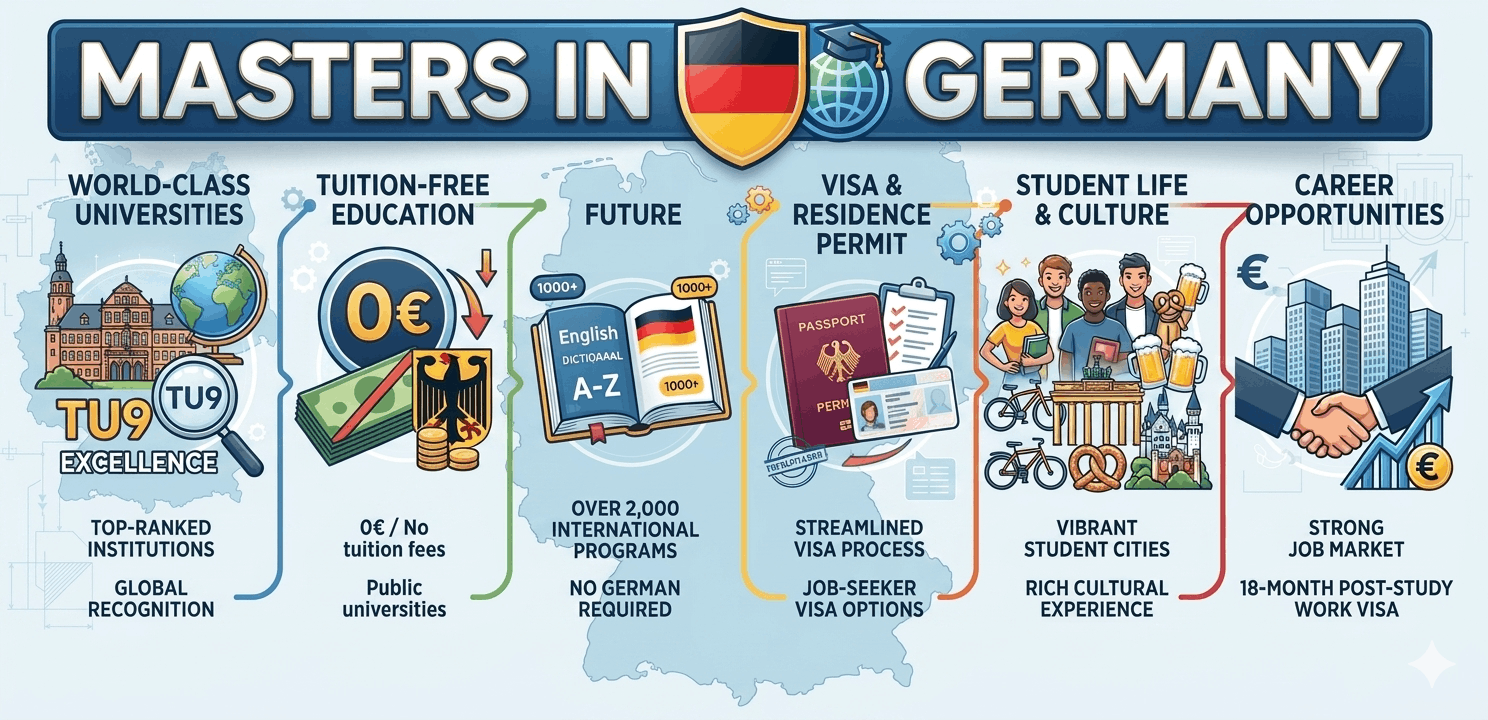
Choosing to pursue a Masters in Germany gives you access to globally recognised universities, research-focused education, and excellent career opportunities after graduation. The country is especially popular among international students because many public universities charge little to no tuition fees, making quality education more affordable than in many other study destinations.
Most master's programmes are completed in 1.5 to 2 years, with options available in engineering, business, computer science, healthcare, and the humanities. Whether you're looking to specialise in your field or improve your global career prospects, this guide covers everything you need to know about Masters in Germany, from top universities and admission requirements to costs, scholarships, visas, and job opportunities.
Key Highlights: Masters in Germany
Key Highlights | Details |
Programme Duration | 1.5–2 years (most Master's); some 1-year intensive options |
Medium of Instruction | German (primary); 1,900+ English-taught Master's programmes |
Tuition Fees (Most Public Universities) | Free (semester fee of EUR 150–400/ INR 13.5K–36K per semester) |
Tuition Fees (Baden-Württemberg, non-EU) | EUR 1,500 (INR 1.35L) per semester |
Tuition Fees (TUM, most programmes) | EUR 4,000–6,000 (INR 3.6L–5.4L) per semester |
Top Universities | TUM (#25 globally), LMU Munich (#61), Heidelberg, Freie Universität Berlin |
Financial Proof (Blocked Account) | EUR 11,904 (INR 10.7L) for 12 months (EUR 992 per month) |
Student Visa Type | German Student Visa (National Visa, Type D) |
Part-Time Work Rights | 120 full days or 240 half days per year |
Post-Study Work | 18 months to seek employment after graduation |
Cost of Living | EUR 992–1,043 (INR 89.3K–93.9K) per month, excluding rent |
Main Intakes | Winter Semester (October); Summer Semester (April) |
Why Pursue a Masters in Germany?
Study in Germany appeal for international master's students rests on a combination that very few countries offer simultaneously: tuition-free public universities, globally ranked institutions, and a large, export-driven economy with consistent demand for skilled graduates.
1. Free Tuition at Most Public Universities:
In 2014, all German federal states scrapped tuition fees, so most Bachelor's and many Master's programmes are free for everyone. The only exceptions are Baden-Württemberg, which charges €1,500 per semester for non-EU students, and TUM, which has introduced fees for most master's programmes since 2023.
2. Deep Pool of Globally Ranked Universities:
Germany had the highest number of upward moves in the QS World University Rankings 2027, with 85 institutions featured, more than China, and a strong cluster of research-intensive universities in Munich, Berlin, and Heidelberg.
3. Post-Study Work Pathway:
After completing a master's degree in Germany, international graduates receive an 18-month residence permit to seek employment, with no restrictions on the type of work or employer during this period.
4. English-Taught Options at Scale:
More than 1,900 English-taught master's programmes are available across German public universities, making it accessible to most international applicants without German language skills for many disciplines.
Top Universities for Masters in Germany
Germany's university landscape has two clear clusters: the Munich pair of TUM and LMU, and the Berlin alliance of Freie Universität, Humboldt, and TU Berlin. Beyond these, Heidelberg, Karlsruhe, and RWTH Aachen carry strong global reputations in their core disciplines.
TUM is ranked 25th globally in the QS World University Rankings 2027, retaining its position as the best university in the European Union, noted specifically for top performance in engineering, natural sciences, and employer reputation, according to TUM's own official rankings page.
Top Universities Offering Masters in Germany:
University | QS World Ranking 2027 | Known For |
Technical University of Munich (TUM) | #25 | Engineering, Computer Science, Natural Sciences, Medicine, Management |
Ludwig-Maximilians-Universität München (LMU) | #61 | Medicine, Law, Philosophy, Life Sciences, Humanities |
Heidelberg University | #86 | Medicine and Life Sciences (top 33 globally), Humanities, Natural Sciences |
Freie Universität Berlin | #98 | Humanities, Social Sciences, International Research Network |
Karlsruhe Institute of Technology (KIT) | #110 | Engineering, Computer Science, Natural Sciences |
RWTH Aachen University | #104 | Mechanical Engineering (top 25 globally), Electrical Engineering |
Humboldt-Universität zu Berlin | #140 | Humanities, Social Sciences, Natural Sciences |
TU Berlin | #158 | Electrical Engineering, Computer Science, Architecture |
University of Mannheim | #425 | Business and Economics (top European business school) |
University of Hamburg | #209 | Natural Sciences, Social Sciences, Sustainability |
Popular Masters Programmes in Germany
Germany's strength is spread unevenly across disciplines, with engineering, computer science, and natural sciences carrying particularly strong international reputations, alongside growing English-taught business and data science tracks.
Most Popular Masters Programmes in Germany:
Field of Study | Popular Programmes |
Engineering | MSc Mechanical Engineering, MSc Civil Engineering, MSc Aerospace Engineering |
Computer Science and AI | MSc Computer Science, MSc AI and Machine Learning, MSc Data Engineering |
Business and Management | MSc Business Administration, MBA, MSc Supply Chain Management |
Natural Sciences | MSc Physics, MSc Chemistry, MSc Mathematics |
Life Sciences and Medicine | MSc Biomedical Science, MSc Bioinformatics, MSc Neuroscience |
Data Science | MSc Data Science, MSc Computational Science, MSc Business Analytics |
Architecture and Urban Planning | MSc Architecture, MSc Urban Planning, MSc Sustainable Architecture |
Course Structure of Masters in Germany
Most master's programmes in Germany run for two years and follow the European ECTS credit framework, combining core modules with a specialisation track and a research thesis. A small number of intensive programmes run for 1.5 years. The academic year splits into two semesters: Winter (October–March) and Summer (April–September).
General Master's Course Structure in Germany:
Programme Stage | Key Components |
Core Modules | Advanced discipline-specific theory, research methods, quantitative frameworks |
Specialisation Track | Elective modules aligned to career direction or research area |
Seminars and Labs | Research seminars, laboratory work, or industry-linked projects |
Master's Thesis | Independent research project, typically 6 months duration |
Top Specialisations for Masters in Germany
Germany's specialisation strengths map directly onto its industrial base. Automotive, chemicals, pharmaceuticals, and technology dominate employer demand and align closely with the country's top-ranked research areas.
Specialisation | Universities Known For It |
Automotive and Mechanical Engineering | TUM, RWTH Aachen, KIT |
AI and Data Science | TUM, TU Berlin, LMU |
Pharmaceutical and Life Sciences | Heidelberg University, LMU |
Business and Management | University of Mannheim, LMU, TU Berlin |
Electrical and Computer Engineering | RWTH Aachen, KIT, TU Berlin |
Sustainability and Environmental Sciences | KIT, University of Freiburg, Hamburg |
Eligibility and Admission Requirements for Masters in Germany
Admission to a Masters in Germany requires a recognised bachelor's degree, German or English language proficiency depending on the programme, and in some cases, a numerus clausus (NC) or minimum grade requirement set by the university.
Eligibility Criteria for Masters in Germany:
Requirement | Details |
Academic Qualification | Recognised bachelor's degree or equivalent; must be equivalent to a German bachelor's (typically 180 ECTS credits) |
German Language | TestDaF or DSH for German-taught programmes; typically C1 level required |
English Language | IELTS 6.5–7.0 or TOEFL 90–100+ for English-taught programmes |
Credential Recognition | Foreign degrees must be assessed for equivalence; many universities use anabin database or uni-assist for evaluation |
Motivation Letter | Required at most universities; should clearly explain research interests and career goals |
GRE / GMAT | Not typically required at most German public universities; some TUM and LMU programmes may recommend |
Tuition Fees for Masters in Germany
Tuition fees in Germany are the most consistently cited reason international students choose it over the UK, US, or Australia. The default at public universities is no tuition, but three clear exceptions exist that students must check before applying.
Germany's public universities abolished general tuition fees in 2014. Most master's programmes at public universities remain free for all students regardless of nationality, with the main costs being the semester fee covering administration, student union services, and often a regional public transport pass.
Tuition Fee Structure for Masters in Germany:
Category | Annual Tuition Fees |
Most Public Universities (all nationalities) | Free (semester fee of EUR 150–400/INR 13.5K–36K per semester) |
Baden-Württemberg public universities (non-EU only) | EUR 3,000 (INR 2.7L) per year (EUR 1,500 per semester) |
TUM (most master's programmes, introduced from 2023) | EUR 8,000–12,000 (INR 7.2L–10.8L) per year (EUR 4,000–6,000 per semester) |
Private Universities (Germany-wide) | EUR 10,000–40,000 (INR 9L–36L) per year |
Note: TUM is currently the only major public university in Germany to have introduced substantial tuition fees for international master's students. Most other Bavarian universities, including LMU, have not followed this approach and remain free.
Cost of Living in Germany for Masters Students
Living costs in Germany vary significantly by city. Munich is the most expensive, while cities like Leipzig, Dresden, and Essen are among the most affordable university destinations in the country.
The estimated monthly cost for a single person in Germany is €1,001.4 (INR 90.1K), excluding rent. Munich sits slightly higher at €1,043 (INR 93.9K) and Berlin slightly lower at €981 (INR 88.3K), both excluding rent.
Estimated Monthly Living Cost Breakdown (Numbeo, 2026):
Expense Category | Munich (Monthly) | Berlin (Monthly) |
Accommodation (1BR) | EUR 1,200–1,800 (INR 1.08L–1.62L) | EUR 1,000–1,400 (INR 90K–1.26L) |
Food and Groceries | EUR 250–350 (INR 22.5K–31.5K) | EUR 200–300 (INR 18K–27K) |
Transport | EUR 63 (INR 5.7K) flat (Deutschlandticket) | EUR 63 (INR 5.7K) flat (Deutschlandticket) |
Health Insurance | EUR 110–120 (INR 9.9K–10.8K) | EUR 110–120 (INR 9.9K–10.8K) |
Source: Numbeo Cost of Living, Germany
Note: The Deutschlandticket costs EUR 63 per month (approximately INR 5,700) from January 2026 and offers unlimited travel on local and regional trains, buses, trams, and metro services across Germany. It is one of Europe's best-value public transport options for students.
Visa Financial Requirement: In 2026, non-EU students must deposit EUR 11,904 (approximately INR 10.7 lakh) into a blocked account (Sperrkonto) before applying for a German student visa. This amount is released in monthly instalments of EUR 992 (approximately INR 89,300) to help cover living expenses during their stay.
Top Scholarships for Masters in Germany
Several official scholarship programmes support international students pursuing a Masters in Germany. The German Academic Exchange Service (DAAD) is the primary government-backed funding body, administering Germany's largest international scholarship programme.
Scholarship | Eligibility | Coverage |
DAAD Scholarships for Development-Related Postgraduate Courses | Students from developing countries; must return to home country after studies | Monthly stipend EUR 934 (INR 84K) for Master's students, plus travel allowance and health insurance |
Deutschlandstipendium | Students at a participating German university; merit-based; no nationality restriction | EUR 300 (INR 27K) per month for at least two semesters |
Heinrich Böll Foundation Scholarships | Students with exceptional academic achievement and social engagement; open to international students | EUR 812–992 (INR 73.1K–89.3K) per month plus EUR 100 research allowance |
Konrad-Adenauer-Stiftung Scholarships | International students at a German university; merit and civic engagement | Monthly stipend plus study allowance |
Erasmus+ Scholarships | Students from partner countries; exchange-based; enrolled at participating institutions | Monthly allowance covering tuition and living expenses |
How to Apply for Masters in Germany
Applying for a Masters in Germany is straightforward but involves specific steps around credential recognition and document requirements that differ from applications in the UK, US, or Australia.
Step | Stage | What You Need to Do |
Step 1 | Research and Shortlist | Search English-taught programmes via DAAD's database at daad.de; cross-check university rankings and subject strengths |
Step 2 | Check Credential Equivalence | Use the anabin database (anabin.kmk.org) or contact the university to confirm your bachelor's degree is recognised |
Step 3 | Prepare Documents | Gather transcripts, degree certificates, motivation letter, CV, language test scores, and passport |
Step 4 | Submit Application | Apply via uni-assist (uni-assist.de) or the university's own portal, depending on the institution |
Step 5 | Receive Admission Letter | Once accepted, receive your official Zulassungsbescheid (admission letter) |
Step 6 | Open Blocked Account | Deposit EUR 11,904 (INR 10.7L) into a Sperrkonto at least 6–8 weeks before the visa appointment |
Step 7 | Apply for Student Visa | Submit the National Visa (Type D) application at the German embassy or consulate in your home country |
Step 8 | Enrol and Register | Travel to Germany, enrol at the university, and register with the local residents' registration office (Einwohnermeldeamt) |
Intakes and Application Timeline for Masters in Germany
Germany runs two annual intakes and most universities have firm application deadlines, though the exact dates vary considerably between institutions. Unlike the UK, Germany does not have a centralised UCAS-style application system for postgraduate study.
Masters in Germany Intakes:
Intake | Programme Start | Application Deadline |
Winter Semester (Main) | October | Most deadlines fall between May and July |
Summer Semester (Secondary) | April | Most deadlines fall between November and January |
Key Points:
The Winter Semester is the primary intake across most German universities and offers the widest choice of master's programmes.
Many universities use uni-assist for international application processing, which adds a separate processing fee and should be factored into the timeline.
TUM uses its own admissions portal separate from uni-assist.
Student Visa Requirements for Masters in Germany
Non-EU/EEA students planning to pursue a Masters in Germany must apply for a National Visa (Type D) before travelling. This visa is issued for study purposes and allows entry into Germany, after which students apply for a residence permit.
How the Visa Process Works
The National Visa is applied for at the German embassy or consulate in the home country before departure. After arriving in Germany, students must apply for a residence permit for study purposes at the local Foreigners' Office (Ausländerbehörde) within the validity period of the entry visa.
Eligibility Criteria:
Confirmed admission from a recognised German university (Zulassungsbescheid)
Proof of financial resources of EUR 992 per month (EUR 11,904 per year) via a blocked account
Proof of German or English language proficiency depending on the programme
Proof of health insurance coverage valid in Germany
Financial Requirements:
In 2026, non-EU students must deposit EUR 11,904 (approximately INR 10.7 lakh) into a blocked account (Sperrkonto) before their visa appointment. After arriving in Germany, the amount is released in monthly instalments of EUR 992 (approximately INR 89,300) to help cover living expenses and cannot be withdrawn in full at once. The German student visa application fee is EUR 75 (approximately INR 6,750).
Documents Required for German Student Visa:
Valid passport (minimum 6 months validity beyond intended stay)
Completed National Visa application form
Official university admission letter (Zulassungsbescheid)
Proof of blocked account (Sperrkonto confirmation) with EUR 11,904 deposited
Academic transcripts and degree certificates
German or English language proficiency certificates
Health insurance certificate valid in Germany
Passport-size photographs per German visa specifications
Visa application fee of EUR 75 (INR 6.75K)
Post-Study Work: 18-Month Job-Seeker Residence Permit:
After successfully completing a master's degree in Germany, international graduates can apply for an 18-month residence permit to seek employment. During this period, there are no restrictions on the type of work or employer, meaning graduates can take any job, including part-time roles, while searching for a skilled position aligned with their qualifications.
Top Cities to Study Masters in Germany
City selection significantly shapes both daily living costs and post-graduation employment prospects. Germany's industrial and economic geography means different cities carry distinct advantages for different disciplines and career directions.
City | Why It is Preferred |
Munich | TUM and LMU; BMW, Siemens, Allianz, and MAN headquarters; highest salaries but highest living costs |
Berlin | TU Berlin, Freie Universität, and Humboldt; largest tech startup ecosystem in Germany; strong AI and digital sector |
Heidelberg | Heidelberg University; biomedical research cluster; SAP headquarters nearby |
Aachen | RWTH Aachen; mechanical and electrical engineering hub; proximity to European automotive and industrial corridor |
Karlsruhe | KIT; strong engineering and technology ecosystem; more affordable than Munich or Berlin |
Hamburg | University of Hamburg; logistics, media, and maritime industries; strong English-speaking international community |
Top Job Opportunities After Masters in Germany
Germany's labour market offers consistent demand for master's-level graduates, particularly in engineering, technology, and data-driven roles. The country had 109,000 unfilled IT positions in 2026 (Bitkom), with vacancies taking 7.7 months to fill on average.
Top Job Roles and Approximate Salaries After Masters in Germany:
Job Role | Approximate Annual Salary (Germany-wide) |
Software Engineer | EUR 58,000–79,000 (INR 52.2L–71.1L) |
Software Engineer (Munich) | EUR 58,000–85,369 (INR 52.2L–76.8L) |
Software Engineer (Berlin) | EUR 60,750–84,250 (INR 54.7L–75.8L) |
Data Scientist | EUR 58,000–77,750 (INR 52.2L–70L) |
Data Engineer | EUR 60,688–81,350 (INR 54.6L–73.2L) |
Machine Learning Engineer | EUR 57,000–77,500 (INR 51.3L–69.8L) |
Source: Glassdoor
Note: Senior AI engineers in Munich reach €131,000 (INR 1.18Cr) at the 75th percentile, while US tech companies including Meta (Berlin/Munich) report median total compensation of €279,000 (INR 2.51Cr) across engineering roles.
Final Thoughts from the Author
One of the biggest advantages of pursuing a Masters in Germany is that it gives you access to quality education without the financial burden often associated with studying abroad. But choosing the right university is only one part of the journey. The course you select, the city you live in, and the practical experience you gain during your studies can all shape your future career.
Take the time to research your options, understand the admission process, and plan your finances in advance. A well-planned decision today can make your transition to studying and living in Germany much smoother and help you make the most of everything the country has to offer.
Planning your MBA journey abroad? Book a free 1:1 counselling session for personalized guidance on universities, admissions, scholarships, and visa requirements.
Popular Study Abroad Programs from Top Universities:
· MBA in Healthcare Management Abroad
· Masters in Artificial Intelligence Abroad