Masters in Netherlands
Table of Contents
- Top Universities for Masters in Netherlands
- Types of Masters in Netherlands
- Eligibility Requirements for Masters in Netherlands
- Cost of Studying Masters in Netherlands
- Top Scholarships for Masters in Netherlands
- Masters in Netherlands Intakes and Admission Deadlines
- How to Apply for Masters in Netherlands
- Student Visa Requirements for Masters in Netherlands
- Top Cities for Masters in Netherlands
- Orientation Year Visa After Masters in Netherlands
- Top Job Opportunities After Masters in Netherlands
- Conclusion
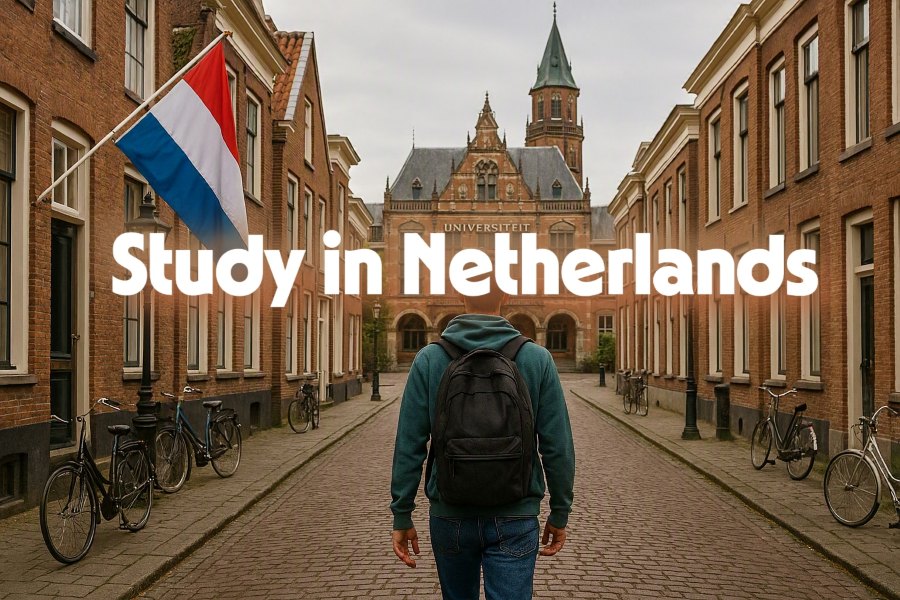
Masters program in Netherlands is highly sought after for their globally recognized degrees, extensive English taught courses and post study work opportunities. Degrees last 1 to 2 years, with tuition fees for international students ranging from €13,000 to €34,000 per year (₹12 lakh–₹33 lakh) depending on the university, specialization, and program structure. Study in Netherlands for globally ranked universities and offers over 2,000 programs, making Europe's most popular study destinations for international students.
The table below provides a quick overview of Masters in Netherlands for international students.
Particulars | Details |
Degree Level | Masters (Postgraduate) |
Duration | 1–2 Years |
Study Language | English |
Number of English-Taught Programs | 2,000+ |
Approximate Tuition Fees | €13,000–34,000/year (₹12 lakh–₹33 lakh) |
Approximate Living Costs | €12,000–18,000/year (₹11 lakh–₹17 lakh) |
Major Intakes | September, February |
Post-Study Work Visa | 1-Year Orientation Year (Zoekjaar) |
Work Rights During Study | Up to 16 hours/week or full-time seasonal work |
Popular Fields | Engineering, AI, Data Science, Business, Finance |
Top Student Cities | Amsterdam, Delft, Eindhoven, Groningen, Utrecht |
Top Recruiters | ASML, Philips, ING, Shell, Booking.com, Deloitte |
This blog covers everything about Masters in Netherlands, including top universities, admission requirements, tuition fees, scholarships, living expenses, visa requirements, post-study work opportunities, job prospects and application processes. Whether you are interested in Engineering, Data Science, Business, Finance, Artificial Intelligence or Social Sciences, this article provides a complete roadmap for pursuing a master's degree in the Netherlands.
Top Universities for Masters in Netherlands
Masters in Netherlands is premier destination, offering globslly recognized degree, affordable tuitions for it’s English taught programs.Ofered through two primary higher education systems: Research Universities and Universities of Applied Sciences. Research Universities dominate global ranking focus on academic learning and research, while Universities of Applied Sciences emphasize practical training, internships and industry exposure.
The table below highlights the top universities for Masters in Netherlands based on the latest QS World University Rankings 2027:
University | QS World University Rankings 2027 | Approx. Annual Tuition Fee |
Delft University of Technology | #48 | €18,000–25,000 (₹17 lakh–₹24 lakh) |
University of Amsterdam | #60 | €15,000–25,000 (₹14 lakh–₹24 lakh) |
Utrecht University | #113 | €17,000–24,000 (₹16 lakh–₹23 lakh) |
Leiden University | #119 | €16,000–23,000 (₹15 lakh–₹22 lakh) |
Erasmus University Rotterdam | #148 | €18,000–32,000 (₹17 lakh–₹31 lakh) |
Wageningen University & Research | #154 | €14,000–22,000 (₹13 lakh–₹21 lakh) |
Eindhoven University of Technology | #152 | €16,000–22,000 (₹15 lakh–₹21 lakh) |
Types of Masters in Netherlands
Masters in Netherlands are broadly categorized into research oriented and professionally focused programs. Understanding the differences helps students choose programs aligned with their career goals.
The table below explains the primary program types.
Program Type | Duration | Focus Area |
Research Masters | 2 Years | Academic research and PhD preparation |
Taught Masters | 1 Year | Industry-focused academic specialization |
Professional Masters | 1–2 Years | Applied learning and career advancement |
Applied Sciences Masters | 1–4 Years | Practical training, internships, industry projects |
Research Universities for Masters in Netherlands
Research Universities focus on theoretical knowledge, analytical thinking and independent research. These institutions are ideal for students interested in research intensive careers or doctoral studies.
Universities of Applied Sciences for Masters in Netherlands
Universities of Applied Sciences focus on professional skills, industry collaboration, internships and practical learning. These programs are particularly suitable for students seeking direct employment after graduation.
Course Structure of Masters in Netherlands
Masters in Netherlands have up to 6 study components that cover advanced academic learning and provide practical industry exposure. Most programs emphasize project based learning, interdisciplinary collaboration and international perspectives.
The table below outlines the typical course structure.
Study Component | Coverage |
Core Modules | Advanced subject-specific learning |
Elective Courses | Specialized areas of study |
Research Projects | Academic or applied research |
Industry Projects | Company-sponsored assignments |
Internships | Available in selected programs |
Masters Thesis | Independent research project |
Eligibility Requirements for Masters in Netherlands
Admission requirements for Masters in Netherlands vary by universities and programs. For Indian students should hold a recognized 3-to-4-year Bachelors degree, demonstrate English language proficiency and submit supporting documents like a CV, SOP, and LORs. Students applying for Masters in Netherlands must demonstrate strong academic performance and relevant educational backgrounds.
The following tables provide detailed eligibility requirements.
Requirement | Details |
Bachelor's Degree | Recognized undergraduate degree in a relevant discipline |
Minimum GPA requirement | GPA of 7.5 or 70%-75% in undergraduate studies |
Relevant Subject Background | Required for specialized Masters programs |
Statement of Purpose | Clearly outlining academic and career goals |
Letters of Recommendation | Usually 1–3 academic or professional references |
Resume/CV | Updated educational and professional profile |
Passport | Min.12 months validity at the time of application and official offer letter from recognized Dutch university
|
Entrance Exam Requirements for Masters in Netherlands
Some Top-tier universities particularly in business and economics, require standardized tests like the following:
Examination | Requirement |
GMAT | 600+ |
GRE | Min. Score of 310–330 |
English Language Requirements for Masters in Netherlands
Required for all English taught programs are generally need an IELTS and TOEFL with following score requirements:
Test | Minimum Requirement |
IELTS Academic | 6.5–7.0 |
TOEFL iBT | 90–100 |
PTE Academic | 65–75 |
Cambridge English | Accepted by selected universities |
Cost of Studying Masters in Netherlands
The cost of pursuing Masters in Netherlands consists primarily of tuition fees and living expenses. While tuition varies by university and program, living costs depends on the city chosen.
Tuition Fees for Masters in Netherlands:
University Category | Approximate Annual Tuition Fee |
Research Universities | €13,000–25,000 (₹12 lakh–₹24 lakh) |
Technical Universities | €15,000–30,000 (₹14 lakh–₹29 lakh) |
Business Schools | €20,000–34,000 (₹19 lakh–₹33 lakh) |
Applied Sciences Universities | €10,000–18,000 (₹9 lakh–₹17 lakh) |
Living Costs for Masters in Netherlands
Expense Category | Approximate Annual Cost |
Accommodation | €6,000–10,000 (₹5.8 lakh–₹9.7 lakh) |
Food & Groceries | €2,500–4,000 (₹2.4 lakh–₹3.9 lakh) |
Transportation | €800–1,500 (₹77,000–₹1.4 lakh) |
Health Insurance | €1,200–1,800 (₹1.1 lakh–₹1.7 lakh) |
Miscellaneous Expenses | €1,500–3,000 (₹1.4 lakh–₹2.9 lakh) |
Top Scholarships for Masters in Netherlands
The Dutch government and universities provide numerous scholarships that help reduce the financial burden for international students pursuing Masters in Netherlands.
The table below highlights major scholarship opportunities.
Scholarship | Eligibility | Coverage |
Holland Scholarship | Non-EEA international students | €5,000 one-time grant |
Orange Knowledge Programme | Selected developing countries | Partial to full funding |
Erasmus Mundus Scholarships | Outstanding academic applicants | Full tuition and living costs |
TU Delft Excellence Scholarships | High-achieving students | Full or partial tuition |
Utrecht Excellence Scholarship | Academic excellence | Partial or full tuition |
Amsterdam Merit Scholarship | Outstanding international students | Tuition fee reduction |
Masters in Netherlands Intakes and Admission Deadlines
Masters in Netherlands programs particularly offer September and February intakes, although the September intake is the most popular among international students for it’s wider course availability, scholarship opportunities, housing options and internship access.
The table below highlights the primary admission cycles for Masters in Netherlands.
Intake | Application Period | Program Start |
September Intake | October – May | September |
February Intake | June – November | February |
Rolling Admissions | Varies by University | Multiple Dates |
Students targeting competitive universities such as TU Delft, University of Amsterdam or Erasmus University Rotterdam should ideally begin preparations 8–12 months before the intended intake.
How to Apply for Masters in Netherlands
The application process for Masters in Netherlands is centralized through the Studielink portal for most universities. However, some institutions may require additional university-specific applications and document submissions after Studielink registration.
The table below outlines the complete application process for Masters in Netherlands.
Step | Process | Details |
Step 1 | Research Programs | Compare universities, rankings, tuition fees, curriculum, scholarships, and career outcomes before shortlisting programs. |
Step 2 | Check Eligibility | Review academic requirements, prerequisite subjects, English language requirements, and any additional program-specific conditions. |
Step 3 | Prepare Test Scores | Complete IELTS, TOEFL, PTE, GMAT, or GRE examinations where required by the university. |
Step 4 | Gather Documents | Prepare transcripts, degree certificates, SOP, recommendation letters, CV, passport, and test score reports. |
Step 5 | Apply via Studielink | Register on the Studielink portal and submit applications to selected universities. |
Step 6 | Submit Additional Requirements | Complete any university-specific application forms, interviews, portfolios, or assessments. |
Step 7 | Receive Admission Decision | Universities issue conditional or unconditional offers depending on document verification. |
Step 8 | Pay Tuition Deposit | Accept the offer and complete any required tuition fee payment. |
Step 9 | Apply for Visa | Begin residence permit and visa procedures through the university. |
Student Visa Requirements for Masters in Netherlands
Students outside the EU/EEA pursuing Masters in Netherlands generally require a Dutch Residence Permit (VVR) and a Provisional Residence Permit (MVV) depending on nationality. Most universities act as the official sponsor and manage the visa application process on behalf of students.
The table below outlines the student visa requirements for Masters in Netherlands.
Requirement | Details |
Admission Letter | Official confirmation of enrollment from a recognized Dutch institution |
Valid Passport | Must remain valid throughout the intended study period |
Proof of Financial Means | Evidence showing ability to cover tuition and living expenses |
Academic Documents | Degree certificates, transcripts, and qualification records |
English Language Test Scores | IELTS, TOEFL, PTE, or equivalent proof of proficiency |
Tuberculosis Test | Required for students from selected countries after arrival |
Health Insurance | Mandatory throughout the study duration |
Residence Permit Application | Usually submitted by the university on behalf of students |
Passport Photographs | As per Dutch immigration specifications |
Visa Application Fee | Applicable immigration processing charges |
Top Cities for Masters in Netherlands
Netherlands offers several student-friendly cities known for academic excellence, innovation ecosystems, multinational employers, and strong graduate employment prospects. And the living costs alone range from €800 to €1,400 (roughly ₹88,000 to ₹1,55,000) per month, varying significantly depending on the city you choose
The table below highlights the best cities for Masters in Netherlands.
City | Advantages for Students |
Amsterdam | Financial hub with strong opportunities in business, technology, media, finance, and international trade. Home to multinational employers and startups. |
Delft | Engineering and technology powerhouse centered around TU Delft, offering excellent research and innovation opportunities. €830 to €900 per month (roughly INR 10.7 Lakhs per year). |
Eindhoven | Europe's leading technology and semiconductor hub, home to ASML, Philips, and high-tech industries. €1,200 and €1,850 per month. |
Groningen | Popular student city with affordable living costs and a vibrant international student community. Living expenses range between €616 and €1,560 per month. |
Utrecht | Central location with strong research institutions, healthcare sector, and business opportunities. Approx.€1,000 to €1,400 per month |
Rotterdam | Global logistics and finance center featuring one of Europe's largest ports and strong business networks. €950 to €2,100 per month. |
Orientation Year Visa After Masters in Netherlands
The biggest advantages of pursuing Masters in Netherlands is access to the Orientation Year Visa (Zoekjaar). This post-study work scheme allows international graduates to remain in the Netherlands for up to one year after graduation to search for employment or start a business.
The Orientation Year Visa provides graduates with unrestricted access to the Dutch labor market, making it significantly easier to transition from education to employment.
The table below summarizes the benefits.
Category | Details |
Visa Name | Orientation Year Visa (Zoekjaar) |
Duration | Up to 1 Year |
Work Restrictions | No employer sponsorship required |
Employment Flexibility | Full-time work permitted |
Entrepreneurship Opportunities | Allowed |
Pathway to Skilled Migration | Available through highly skilled migrant schemes |
Many international graduates report that while English-speaking opportunities are available, particularly in technology, engineering, finance, and data science, learning Dutch significantly improves long-term career prospects and employability.
Top Job Opportunities After Masters in Netherlands
The Dutch economy is among Europe's most innovation-driven economies, creating strong demand for highly skilled graduates across engineering, technology, finance, healthcare, logistics, sustainability, and consulting sectors.
The table below highlights popular job opportunities after completing Masters in Netherlands.
Job Role | Approximate Annual Salary | Top Recruiters |
Data Scientist | €50,000–75,000 (₹48 lakh–₹72 lakh) | ASML, Booking.com, Adyen |
Software Engineer | €50,000–80,000 (₹48 lakh–₹77 lakh) | Philips, Microsoft, Amazon |
AI Engineer | €55,000–85,000 (₹53 lakh–₹82 lakh) | ASML, IBM, NVIDIA |
Financial Analyst | €45,000–70,000 (₹43 lakh–₹67 lakh) | ING, Rabobank, ABN AMRO |
Business Analyst | €45,000–75,000 (₹43 lakh–₹72 lakh) | Deloitte, PwC, EY |
Supply Chain Manager | €50,000–80,000 (₹48 lakh–₹77 lakh) | Unilever, Heineken, DHL |
Mechanical Engineer | €48,000–75,000 (₹46 lakh–₹72 lakh) | Philips, Shell, ASML |
Sustainability Consultant | €45,000–70,000 (₹43 lakh–₹67 lakh) | Arcadis, Deloitte, Accenture |
Cybersecurity Analyst | €50,000–80,000 (₹48 lakh–₹77 lakh) | KPMG, IBM, Capgemini |
Conclusion
Masters in Netherlands offers international students a unique combination of world-class education, globally recognized universities, extensive English-taught programs, and strong post-study employment opportunities. With program durations of just one to two years, students can quickly gain specialized expertise while benefiting from the Netherlands' highly international and innovation-driven academic environment.
Graduates also benefit from strong employer demand, competitive salaries, and access to multinational organizations operating across Europe. While English is widely used professionally, learning Dutch can significantly improve long-term career prospects and integration into the local job market.
Planning to study abroad? Connect with our study abroad experts for personalized guidance on university selection, scholarships, admissions, visa applications, and career planning to help you build a successful future in the Netherlands.