MBA in Netherlands
Table of Contents
- Top Universities for MBA in Netherlands
- Course Structure of MBA in Netherlands
- Eligibility and Admission Requirements for MBA in Netherlands
- Cost of MBA in Netherlands
- Scholarships for MBA in Netherlands
- Intakes and Application Timeline for MBA in Netherlands
- How to Apply for MBA in Netherlands
- Student Visa Requirements for MBA in Netherlands
- Work Opportunities While Studying MBA in Netherlands
- Top Cities for MBA in Netherlands
- Career Opportunities After MBA in Netherlands
- Conclusion
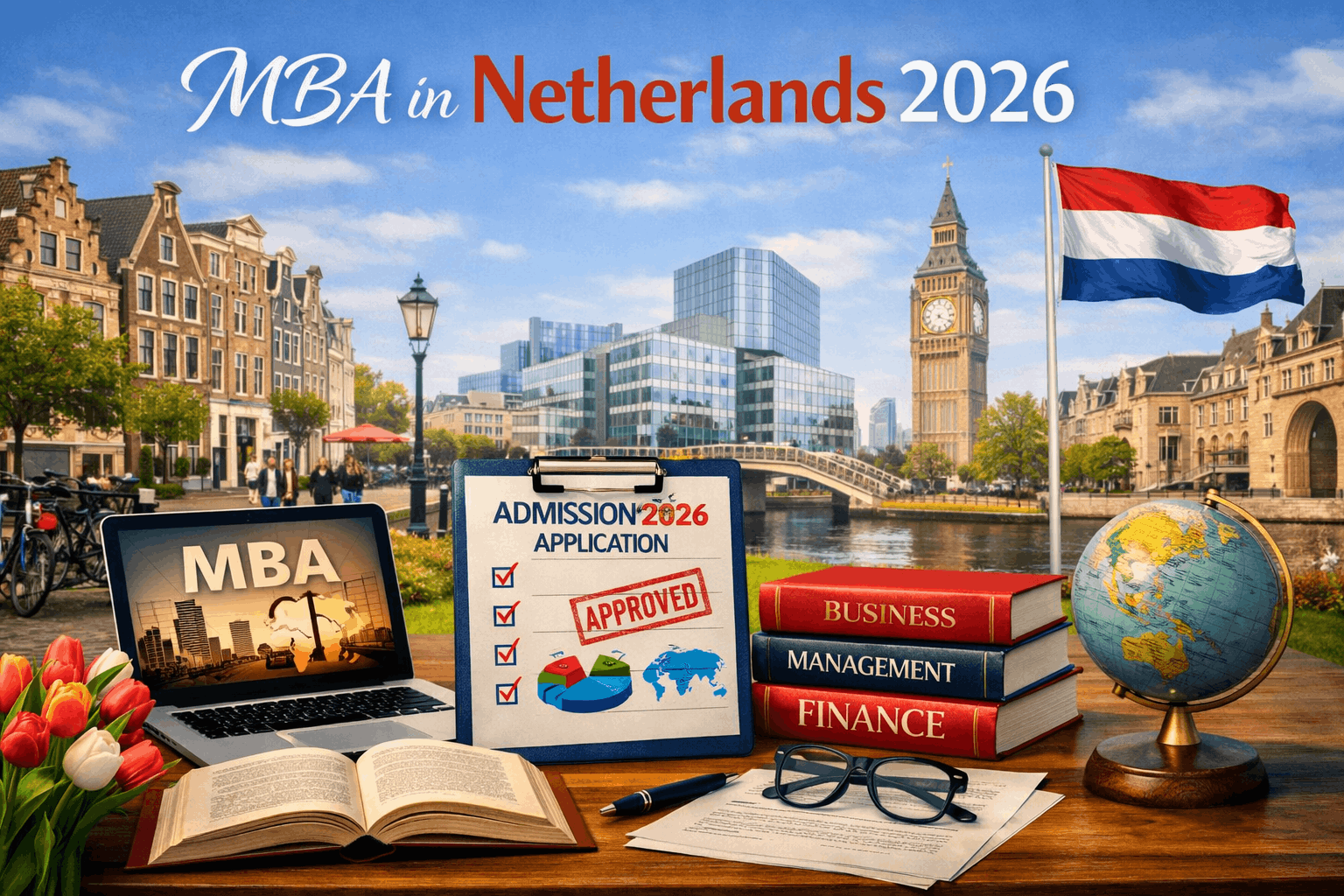
An MBA in Netherlands typically takes 12 to 18 months to complete and costs between EUR 40,000 and EUR 70,000 (approx. Rs. 36L to Rs. 63L), positioning it as a strong mid-range option among European business schools. The programme is widely regarded for its focus on sustainability, leadership, and international business, reflecting the Netherlands' position as a globally connected economy.
Top Dutch business schools also offer the Orientation Year visa after graduation, allowing students to remain in the country and search for employment across Europe's gateway markets. For students seeking a globally respected qualification with practical post-study options, an MBA in Netherlands delivers strong value.
Dreaming of studying in the Netherlands? Check top universities, admission requirements, tuition fees, scholarships, and career opportunities in one comprehensive guide.
Key Highlights: MBA in Netherlands
Key Point | Details |
Programme Duration | 1 to 2 years full-time |
Degree Awarded | Master of Business Administration (MBA) |
Accreditation | AACSB, EQUIS, or AMBA at select universities |
Approx. Annual Tuition Fee | EUR 15,000–65,000 (approx. Rs. 13.5L–Rs. 58.5L) |
Top Universities | Rotterdam School of Management, Amsterdam Business School, Maastricht University, Nyenrode Business University, Tilburg University |
Core Focus Areas | Strategy, Finance, Marketing, Operations, Leadership, Sustainability |
Work Experience Required | 2 to 5 years preferred at most programmes |
Post-Study Work Option | Orientation Year Permit (Zoekjaar) up to 1 year |
Career Outcomes | Management Consultant, Business Analyst, Strategy Manager, Operations Director, Financial Manager |
Scholarship Options | Holland Scholarship, university merit awards, Orange Tulip Scholarship |
Top Universities for MBA in Netherlands
The Netherlands has several well-regarded business schools offering MBA abroad programmes that are recognised by global employers and consistently place graduates in consulting, finance, technology, and operations roles. AACSB, EQUIS, and AMBA accreditations are the key quality markers to look for when shortlisting. Programme reputation, accreditation status, career placement record, industry connections, and city should all be compared before finalising a shortlist.
University | QS World Ranking 2026 | Approx. Annual Tuition |
Erasmus University Rotterdam (Rotterdam School of Management) | #174 | EUR 35,000–55,000 (approx. Rs. 31.5L–Rs. 49.5L) |
University of Amsterdam (Amsterdam Business School) | #53 | EUR 20,000–35,000 (approx. Rs. 18L–Rs. 31.5L) |
Maastricht University (School of Business and Economics) | #284 | EUR 15,000–28,000 (approx. Rs. 13.5L–Rs. 25.2L) |
Nyenrode Business University | Not ranked globally | EUR 30,000–65,000 (approx. Rs. 27L–Rs. 58.5L) |
Tilburg University (Tilburg School of Economics and Management) | #351–400 | EUR 15,000–25,000 (approx. Rs. 13.5L–Rs. 22.5L) |
VU Amsterdam (School of Business and Economics) | #251–300 | EUR 18,000–30,000 (approx. Rs. 16.2L–Rs. 27L) |
University of Groningen (Faculty of Economics and Business) | #171 | EUR 15,000–25,000 (approx. Rs. 13.5L–Rs. 22.5L) |
Course Structure of MBA in Netherlands
Understanding the course structure helps students assess whether a programme fits their career goals. MBA programmes in the Netherlands are typically built around core business fundamentals in the first phase, followed by elective specialisation tracks and an applied project or thesis.
Several programmes incorporate international study weeks, company visits, and consulting projects that connect classroom learning to real business challenges in the Dutch and European market.
Core Programme Structure
The core curriculum covers essential business disciplines that apply across industries and geographies. Most Dutch MBA programmes also integrate sustainability, ethics, and international business perspectives into the core, reflecting the Netherlands' position as a globally oriented trading economy.
Programme Stage | Key Components |
Core Business Modules | Financial accounting, managerial economics, marketing, organisational behaviour, business strategy |
International Business Modules | Global strategy, cross-cultural management, European business environment, trade and policy |
Leadership and Strategy | Change management, leadership development, ethics, stakeholder management |
Analytics and Technology | Business analytics, digital transformation, data-driven decision-making, operations technology |
Sustainability and Innovation | Circular economy, corporate responsibility, sustainable business models, innovation management |
Electives and Concentrations | Finance, consulting, entrepreneurship, supply chain, technology management |
Capstone or Applied Project | Consulting project, business case study, or applied research dissertation |
Top Specialisations in MBA in Netherlands
Specialisations allow students to focus elective coursework around a specific function or industry. Choosing a concentration that aligns with the Netherlands' active hiring sectors and the strengths of the chosen business school tends to produce the strongest post-graduation placement outcomes.
Specialisation | Focus Areas |
Management Consulting | Strategy, problem-solving frameworks, client management, process improvement |
Finance and Investment | Corporate finance, portfolio management, financial modelling, capital markets |
Entrepreneurship and Innovation | Venture development, startup strategy, innovation management, funding models |
Supply Chain and Logistics | Operations management, global logistics, procurement, supply chain technology |
Sustainability and Corporate Responsibility | Circular economy, ESG strategy, sustainable operations, impact measurement |
Technology and Digital Transformation | IT strategy, digital business models, data governance, technology management |
International Business | Global strategy, cross-cultural management, trade policy, emerging markets |
Eligibility and Admission Requirements for MBA in Netherlands
Admission to an MBA in Netherlands requires a recognised undergraduate degree, English language proficiency, professional work experience, and in many cases GMAT or GRE scores. Requirements vary by university and programme tier, but most AACSB and EQUIS-accredited programmes follow a broadly consistent admissions framework. International students should review each institution's official admissions page carefully before applying.
Academic Requirements
A bachelor's degree from a recognised institution is the standard academic requirement. Most Dutch MBA programmes accept graduates from any discipline, and prior business education is not typically mandatory. Academic performance, professional experience, and career clarity carry significant weight alongside the degree.
University Tier | Academic Expectations |
Top Universities (RSM, Amsterdam Business School) | Four-year bachelor's degree; strong academic standing; 3 to 5 years of professional experience preferred |
Mid-Tier Universities (Maastricht, Tilburg, VU Amsterdam) | Bachelor's degree with solid academic performance; 2 to 3 years of work experience advantageous |
Other Universities (Groningen, Nyenrode) | Recognised undergraduate degree; broader background acceptance; work experience valued |
English Language Requirements
Most MBA programmes in the Netherlands are taught entirely in English and require proof of English proficiency from non-native speakers. Waivers may apply for students who completed prior degrees entirely in English at a recognised institution.
University Tier | IELTS Academic | TOEFL iBT |
Top Universities (RSM, Amsterdam) | 7.0 or above | 100 or above |
Mid-Tier Universities (Maastricht, Tilburg) | 6.5 to 7.0 | 90 to 100 |
Other Universities (Groningen, Nyenrode) | 6.0 to 6.5 | 80 to 90 |
GMAT, GRE, and Other Admission Requirements
GMAT or GRE scores are required or recommended at several Dutch MBA programmes, particularly at top-tier institutions. Supporting documents are assessed holistically alongside test scores and professional background.
Requirement | Detail |
GMAT or GRE | Required or recommended at most programmes; competitive GMAT range 550 to 680 or above |
Statement of Purpose | Outlines career goals, management experience, and reasons for choosing the programme |
Letters of Recommendation | Two to three professional or academic references |
CV or Resume | Academic background, work experience, leadership roles, and key achievements |
Work Experience | 2 to 5 years preferred; direct management or leadership experience valued |
Interview | Required at select universities as part of the admissions process |
Cost of MBA in Netherlands
The total cost of an MBA in Netherlands includes tuition fees and living expenses, both of which vary by university tier and city. Amsterdam and Rotterdam are the most expensive cities for day-to-day living, while Maastricht, Tilburg, and Groningen offer more manageable costs. Students should plan both components separately and account for exchange rate movement when budgeting in INR.
Tuition Fees for MBA in Netherlands
Tuition fees differ significantly between top-tier private institutions and public universities. Students should always verify current fees on the official university website before applying, as figures are updated annually.
University | Approx. Annual Tuition (International Students) | INR Value |
Rotterdam School of Management | EUR 35,000–55,000/year | Rs. 31.5L–Rs. 49.5L/year |
Amsterdam Business School | EUR 20,000–35,000/year | Rs. 18L–Rs. 31.5L/year |
Nyenrode Business University | EUR 30,000–65,000/year | Rs. 27L–Rs. 58.5L/year |
Maastricht University | EUR 15,000–28,000/year | Rs. 13.5L–Rs. 25.2L/year |
Tilburg University | EUR 15,000–25,000/year | Rs. 13.5L–Rs. 22.5L/year |
VU Amsterdam | EUR 18,000–30,000/year | Rs. 16.2L–Rs. 27L/year |
University of Groningen | EUR 15,000–25,000/year | Rs. 13.5L–Rs. 22.5L/year |
Cost of Living in Netherlands for MBA Students
Living costs in the Netherlands depend on the city, accommodation type, and lifestyle. Amsterdam and Rotterdam sit at the higher end; Maastricht, Tilburg, and Groningen are considerably more manageable.
Students are generally advised to budget approximately EUR 800 to EUR 1,100 (72,000–Rs. 1.26L) per month for living costs, though this varies by city and personal habits.
Expense Category | Amsterdam and Rotterdam | Smaller Cities (Maastricht, Tilburg, Groningen) |
Accommodation | EUR 800–1,400/month (approx. Rs. 72,000–Rs. 1.26L) | EUR 500–900/month (approx. Rs. 45,000–Rs. 81,000) |
Food and Groceries | EUR 300–500/month (approx. Rs. 27,000–Rs. 45,000) | EUR 200–350/month (approx. Rs. 18,000–Rs. 31,500) |
Transport | EUR 80–150/month (approx. Rs. 7,200–Rs. 13,500) | EUR 50–100/month (approx. Rs. 4,500–Rs. 9,000) |
Health Insurance | EUR 100–150/month (approx. Rs. 9,000–Rs. 13,500) | EUR 100–150/month (approx. Rs. 9,000–Rs. 13,500) |
Books and Personal Expenses | EUR 150–300/month (approx. Rs. 13,500–Rs. 27,000) | EUR 100–200/month (approx. Rs. 9,000–Rs. 18,000) |
Total Annual Living Cost | EUR 18,000–28,000 (approx. Rs. 16.2L–Rs. 25.2L) | EUR 12,000–20,000 (approx. Rs. 10.8L–Rs. 18L) |
Scholarships for MBA in Netherlands
Several scholarship options are available for international students pursuing an MBA in Netherlands. Government-funded awards, university-specific fellowships, and bilateral scholarship programmes all represent viable routes to reducing the overall cost. Students should begin scholarship research at least 12 months before the intended intake, as competitive awards require significant preparation time.
Scholarship | Eligibility | Coverage |
Holland Scholarship | Non-EEA students admitted to a Dutch university; strong academic record; first-time applicants to Dutch higher education | EUR 5,000 (approx. Rs. 4.5L) one-time award |
Orange Tulip Scholarship | Indian students at participating Dutch universities; strong academic performance; varies by institution | Partial to full tuition; varies by university and programme |
Erasmus University Rotterdam Merit Scholarships | Admitted to RSM MBA programme; strong academic and professional profile; reviewed at admission | Partial tuition reduction; varies by award |
Amsterdam Business School Scholarships | Admitted to ABS programme; academic merit and professional background assessed at admission | Partial tuition support; varies by award |
Nuffic Scholarships and Fellowships | Various eligibility criteria depending on programme; strong academic and professional record | Varies by programme and scholarship type |
University Merit Fellowships | Admitted to a Dutch university MBA programme; strong GPA and test scores | Partial tuition reduction; varies by institution |
NFP Scholarships (Netherlands Fellowship Programmes) | Professionals from eligible developing countries; mid-career professionals with employer support | Full or partial funding depending on programme |
Intakes and Application Timeline for MBA in Netherlands
Most MBA programmes in the Netherlands follow a single annual intake aligned with the academic year. Some universities offer a limited January entry for select programmes. Applying early within the admission cycle consistently improves both admission outcomes and scholarship consideration, as seat and funding availability reduce with each passing round.
Intake | Programme Start | Application Timeline |
September Intake (Main) | September | Applications open October prior year; deadlines typically January to May |
February Intake (Limited) | February | Available at select universities; applications open August to November |
Note:
The September intake is the primary entry point for MBA programmes in the Netherlands and offers the widest course, specialisation, and scholarship availability.
Most scholarship deadlines fall between January and March, well ahead of the general admissions deadline.
Students applying for the Holland Scholarship or Orange Tulip Scholarship should check individual deadlines as they vary by institution.
How to Apply for MBA in Netherlands
The application process for an MBA in Netherlands involves several steps that need to run in the correct sequence. Test preparation, document compilation, financial proof, and visa processing all overlap during peak periods, so starting early is the most practical approach for any applicant targeting the September intake.
Step | What to Do |
Step 1: Shortlist Universities | Select based on AACSB or EQUIS accreditation, specialisation, fees, location, and scholarship availability |
Step 2: Check Eligibility | Review academic requirements, work experience expectations, GMAT or GRE policies, and English score thresholds |
Step 3: Prepare for Tests | Sit GMAT or GRE; take IELTS or TOEFL well in advance of application deadlines |
Step 4: Compile Documents | Gather transcripts, SOP, two to three LORs, CV, and passport |
Step 5: Submit Applications | Apply via each university's official admissions portal; pay application fees |
Step 6: Attend Interview | Prepare for and attend admissions interview if required by the programme |
Step 7: Accept Offer | Confirm place by accepting the offer and submitting the enrolment deposit |
Step 8: Apply for Student Visa | Submit MVV and residence permit application via IND with financial proof and offer letter |
Step 9: Arrange Pre-Departure | Book accommodation, organise health insurance, and prepare travel documents |
Student Visa Requirements for MBA in Netherlands
International students from outside the EU and EEA pursuing an MBA in Netherlands need a student residence permit and, in most cases, a Machtiging tot Voorlopig Verblijf, which is the authorisation for temporary stay. The university typically sponsors the residence permit application through the IND. Students should begin visa preparation as soon as the official offer letter is received to avoid delays before the programme start date.
Requirement | Detail | Approx. Amount |
Official Offer Letter | From a recognised Dutch university | Required |
Residence Permit Application | Sponsored by the university through IND | Required |
MVV (Entry Visa) | Required for most non-EEA students before travelling | EUR 207 (approx. Rs. 18,630) |
Proof of Financial Capacity | Tuition plus living costs | EUR 950/month (approx. Rs. 85,500/month) as per IND guidelines |
Health Insurance | Mandatory after arrival in the Netherlands | EUR 100–150/month (approx. Rs. 9,000–Rs. 13,500) |
Tuberculosis Test | Required for students from certain countries including India | Cost varies |
English Test Scores | IELTS, TOEFL, or accepted equivalent | University-specific |
Academic Documents | Transcripts, degree certificates, test scores | Required |
Work Opportunities While Studying MBA in Netherlands
International students holding a valid Dutch residence permit for study purposes may work part-time during their programme, subject to meeting the conditions set by IND. Work rights give students the opportunity to manage living expenses and gain relevant Dutch work experience during their MBA.
Role | Work Limit | Approx. Hourly Rate |
Research Assistant | 16 hours/week during term | EUR 12–18/hour (approx. Rs. 1,080–Rs. 1,620/hour) |
Teaching Assistant | 16 hours/week during term | EUR 14–20/hour (approx. Rs. 1,260–Rs. 1,800/hour) |
Business School Support | 16 hours/week during term | EUR 12–16/hour (approx. Rs. 1,080–Rs. 1,440/hour) |
Campus or Admin Support | 16 hours/week during term | EUR 12–15/hour (approx. Rs. 1,080–Rs. 1,350/hour) |
Retail or Hospitality | 16 hours/week during term | EUR 12–15/hour (approx. Rs. 1,080–Rs. 1,350/hour) |
Note: Students whose employer holds a recognised sponsor status may have different work conditions. Students should confirm the current work rights conditions with their university's international office before taking up any employment.
Top Cities for MBA in Netherlands
City selection for an MBA in Netherlands directly influences internship access, corporate network exposure, and post-graduation employment during the Orientation Year. Cities with major corporate headquarters, financial institutions, or logistics hubs offer the most practical environment for MBA graduates.
City | Why It is Preferred |
Rotterdam | Home to Europe's largest port; strong logistics, shipping, and supply chain sector; Rotterdam School of Management proximity |
Amsterdam | Major financial hub; headquarters of global corporations including Shell, Heineken, and ASML; strong consulting and technology presence |
Maastricht | International business environment; Maastricht University's active European network; lower living costs than Amsterdam or Rotterdam |
Eindhoven | Technology and innovation hub; ASML and Philips proximity; growing startup and tech ecosystem |
Utrecht | Centrally located; strong healthcare, technology, and professional services sector |
Groningen | Affordable city with strong university links; energy and sustainability sector connections |
Career Opportunities After MBA in Netherlands
MBA graduates in the Netherlands are well-positioned for leadership roles across consulting firms, financial institutions, technology companies, logistics organisations, and multinational corporations. The Netherlands is home to several Fortune 500 headquarters and has an active professional services market, creating consistent demand for MBA-level talent across sectors.
Job Role | Field | Approx. Annual Salary |
Management Consultant | Consulting firms, Big Four, strategy boutiques | EUR 65,000–100,000 (approx. Rs. 58.5L–Rs. 90L) |
Business Analyst | Technology, finance, operations, consulting | EUR 55,000–85,000 (approx. Rs. 49.5L–Rs. 76.5L) |
Financial Manager | Banking, investment firms, corporate finance | EUR 65,000–100,000 (approx. Rs. 58.5L–Rs. 90L) |
Operations Manager | Logistics, manufacturing, technology, retail | EUR 60,000–90,000 (approx. Rs. 54L–Rs. 81L) |
Strategy Manager | Corporate strategy, consulting, private equity | EUR 70,000–110,000 (approx. Rs. 63L–Rs. 99L) |
Supply Chain Manager | Logistics, manufacturing, FMCG, technology | EUR 60,000–95,000 (approx. Rs. 54L–Rs. 85.5L) |
Marketing Manager | Consumer goods, technology, media, retail | EUR 55,000–90,000 (approx. Rs. 49.5L–Rs. 81L) |
Conclusion
An MBA in Netherlands offers international students a well-structured pathway into the European business job market, backed by AACSB and EQUIS-accredited education, strong corporate network access, and a post-study Orientation Year permit that gives graduates time to establish themselves professionally after completing their degree.
The total cost includes tuition of approximately EUR 15,000 to EUR 65,000 per year (approx. Rs. 13.5L to Rs. 58.5L per year) depending on the university, plus living expenses of approximately EUR 12,000 to EUR 28,000 per year (approx. Rs. 10.8L to Rs. 25.2L per year). Students who apply early, target available scholarships like the Holland Scholarship and Orange Tulip Scholarship, and select programmes aligned with their career direction tend to get the strongest overall return from this investment.
Planning to pursue an MBA in Netherlands? Speak with our study abroad experts for personalised guidance.
Popular Study Abroad Programs from Top Universities