
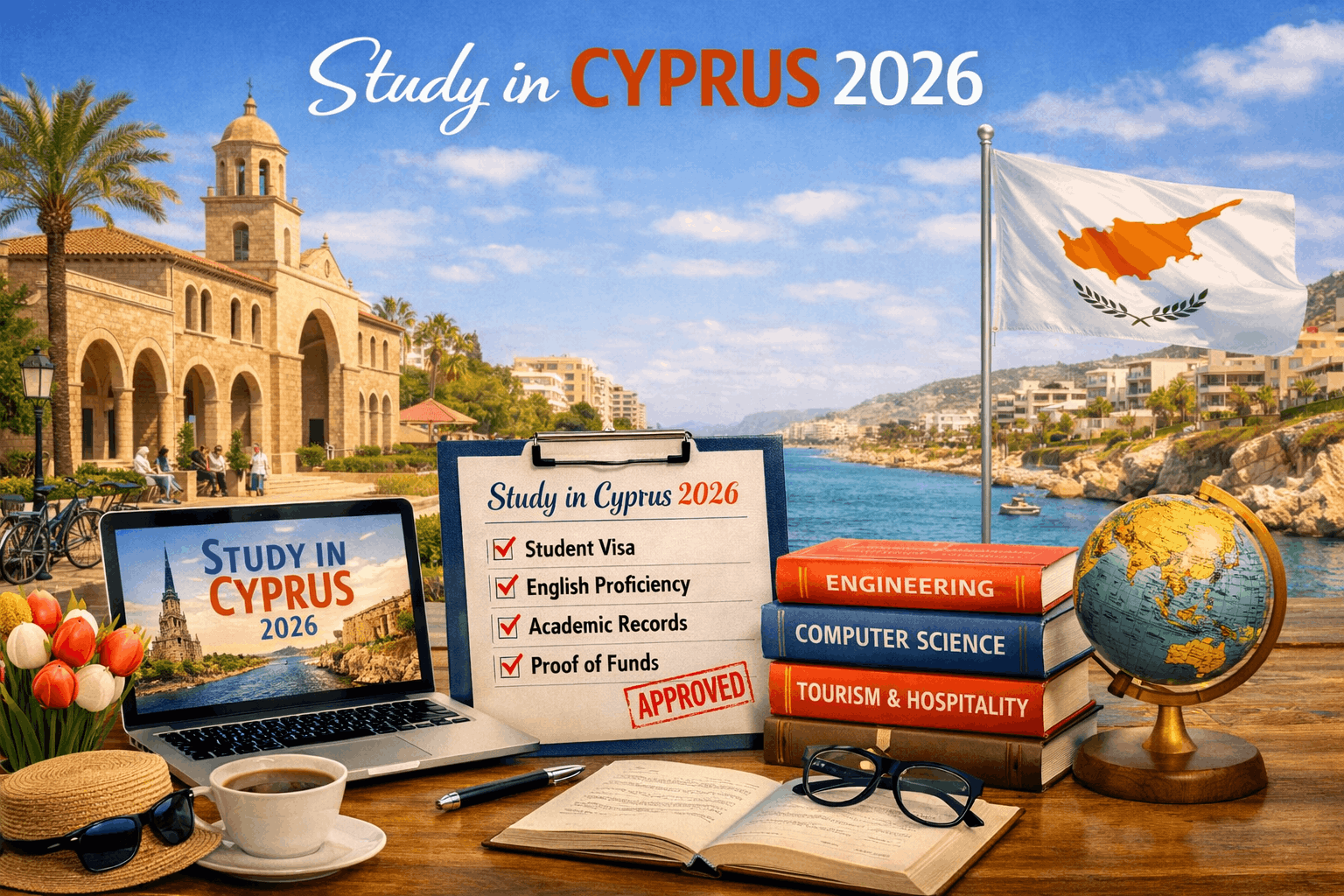
Study in Cyprus
Table of Contents
- Top Universities in Cyprus for International Students
- Best Courses to Study in Cyprus
- Eligibility and Admission Requirements for Study in Cyprus
- How to Apply to Study in Cyprus
- Study in Cyprus Cost
- Scholarships to Study in Cyprus
- Cyprus Student Visa Requirements
- Work Opportunities While Studying in Cyprus
- Career Opportunities After Study in Cyprus
- Conclusion
Study in Cyprus offers an affordable, high-quality European education, with popular programmes available across business, hospitality, computer science, and medicine. Annual tuition fees range from EUR 3,500 to EUR 15,000 (approx. Rs. 3.15L to Rs. 13.5L), making Cyprus one of the more cost-effective EU destinations for international students. Living costs average EUR 700 to EUR 1,200 per month (approx. Rs. 63,000 to Rs. 1.08L per month), depending on the city and lifestyle. International students are also permitted to work part-time during their studies and may qualify for post-study work options after graduation, making Study in Cyprus a practical choice in 2026.
Key Highlights of Study in Cyprus:
Key Point | Details |
Course Duration | 3 to 4 years undergraduate; 1 to 2 years postgraduate; 3 to 4 years PhD |
Course Types | Bachelor's, Master's, MBA, PhD, Medicine (MD) |
Top Universities | University of Cyprus, Cyprus University of Technology, University of Nicosia, Cyprus International University |
Popular Fields | Business, Medicine, Computer Science, Engineering, Hospitality, Law |
Tuition Fees (Public Universities) | EUR 4,000–9,000/year (approx. Rs. 3.6L–Rs. 8.1L) |
Tuition Fees (Private Universities) | EUR 6,000–25,000/year (approx. Rs. 5.4L–Rs. 22.5L) |
Living Expenses | EUR 6,000–9,000/year (approx. Rs. 5.4L–Rs. 8.1L) |
Language of Instruction | English and Greek; most international programmes in English |
Intakes | September (main); February (limited) |
EU Recognition | Degrees recognised across all EU member states |
Top Universities in Cyprus for International Students
Cyprus has both public and private universities offering degrees recognised across the EU. Public universities are generally more research-focused and have lower tuition fees, while private universities often have stronger international student communities and a wider range of English-taught programmes. Students should compare accreditation status, programme focus, location, and fees before shortlisting.
University | Type | Approx. Annual Tuition (International) |
University of Cyprus | Public | EUR 4,000–7,000 (approx. Rs. 3.6L–Rs. 6.3L) |
Cyprus University of Technology | Public | EUR 4,000–8,000 (approx. Rs. 3.6L–Rs. 7.2L) |
University of Nicosia | Private | EUR 7,000–25,000 (approx. Rs. 6.3L–Rs. 22.5L) |
Cyprus International University | Private | EUR 6,000–14,000 (approx. Rs. 5.4L–Rs. 12.6L) |
European University Cyprus | Private | EUR 7,000–22,000 (approx. Rs. 6.3L–Rs. 19.8L) |
Frederick University | Private | EUR 6,000–12,000 (approx. Rs. 5.4L–Rs. 10.8L) |
Open University of Cyprus | Public | EUR 4,000–6,000 (approx. Rs. 3.6L–Rs. 5.4L) |
Best Courses to Study in Cyprus
Cyprus has particular strengths in business, medicine, computer science, hospitality management, and law, reflecting the country's economy and its position as a regional business and tourism hub. The right course depends on academic background, career direction, budget, and whether the student is looking at EU-wide or Cyprus-specific career outcomes.
Business and Management Courses
Business programmes are among the most popular choices for international students in Cyprus, supported by the country's role as a financial services and shipping hub in the Eastern Mediterranean. Several universities offer programmes with international accreditation and exchange partnerships with European institutions.
Course | Common Universities | Approx. Annual Tuition |
MBA | University of Nicosia, Cyprus International University, Frederick University | EUR 8,000–18,000 (approx. Rs. 7.2L–Rs. 16.2L) |
MSc Management | University of Cyprus, European University Cyprus | EUR 6,000–14,000 (approx. Rs. 5.4L–Rs. 12.6L) |
MSc Finance | University of Nicosia, Cyprus University of Technology | EUR 6,000–13,000 (approx. Rs. 5.4L–Rs. 11.7L) |
MSc Shipping and Maritime Management | Cyprus University of Technology, University of Nicosia | EUR 6,000–12,000 (approx. Rs. 5.4L–Rs. 10.8L) |
MSc Business Analytics | University of Nicosia, Frederick University | EUR 6,000–14,000 (approx. Rs. 5.4L–Rs. 12.6L) |
Medicine and Health Sciences Courses
Cyprus has become a notable destination for international students pursuing medicine, particularly because several universities offer English-medium MD programmes with EU recognition at significantly lower cost than Western European or US equivalents. Clinical training is often integrated with local hospitals.
Course | Common Universities | Approx. Annual Tuition |
MD (Doctor of Medicine) | University of Nicosia, European University Cyprus, Cyprus International University | EUR 9,000–25,000 (approx. Rs. 8.1L–Rs. 22.5L) |
BSc Nursing | Cyprus University of Technology, University of Nicosia | EUR 5,000–10,000 (approx. Rs. 4.5L–Rs. 9L) |
MSc Public Health | University of Nicosia, Cyprus University of Technology | EUR 6,000–12,000 (approx. Rs. 5.4L–Rs. 10.8L) |
BSc Pharmacy | University of Nicosia | EUR 8,000–15,000 (approx. Rs. 7.2L–Rs. 13.5L) |
MSc Dentistry | European University Cyprus | EUR 9,000–18,000 (approx. Rs. 8.1L–Rs. 16.2L) |
Computer Science and Engineering Courses
Cyprus has a growing technology sector, supported by government initiatives to position the island as a regional digital hub. Computer science, engineering, and data-related programmes are widely available across both public and private universities, often with strong links to local and European technology employers.
Course | Common Universities | Approx. Annual Tuition |
MSc Computer Science | University of Cyprus, Cyprus University of Technology | EUR 5,000–10,000 (approx. Rs. 4.5L–Rs. 9L) |
MSc Data Science | University of Nicosia, Frederick University | EUR 6,000–12,000 (approx. Rs. 5.4L–Rs. 10.8L) |
MSc Civil Engineering | Cyprus University of Technology, Frederick University | EUR 5,000–10,000 (approx. Rs. 4.5L–Rs. 9L) |
MSc Electrical Engineering | University of Cyprus, Cyprus University of Technology | EUR 5,000–10,000 (approx. Rs. 4.5L–Rs. 9L) |
MSc Cybersecurity | University of Nicosia, European University Cyprus | EUR 6,000–12,000 (approx. Rs. 5.4L–Rs. 10.8L) |
Eligibility and Admission Requirements for Study in Cyprus
Admission requirements for study in Cyprus vary by institution type and programme level, but generally follow standards comparable to other EU destinations. Public universities tend to have slightly more rigorous entry requirements, while private universities often have more flexible admission pathways for international students.
Academic Requirements
A recognised prior qualification at the appropriate level is the standard academic requirement across Cyprus institutions. Specific grade requirements vary by programme and university.
Programme Level | Academic Requirements |
Undergraduate (Bachelor's) | Completed 12th standard or equivalent with minimum 60 percent or equivalent |
Postgraduate (Master's) | Four-year bachelor's degree with minimum 55 to 65 percent or equivalent |
MBA | Bachelor's degree; work experience preferred but not always mandatory |
Medicine (MD) | Strong performance in 12th standard with biology, chemistry, and physics; entrance exam at select universities |
PhD | Master's degree in a relevant field; research proposal required |
English Language Requirements
Most international programmes in Cyprus are taught in English, and proof of English proficiency is required from non-native speakers. Some universities offer internal English placement tests or foundation programmes for students who fall slightly below the requirements.
University Tier | IELTS Academic | TOEFL iBT |
Public Universities | 6.0 to 6.5 | 75 to 90 |
Private Universities | 5.5 to 6.5 | 70 to 90 |
Medicine Programmes | 6.0 to 6.5 | 80 to 90 |
Documents Required for Study in Cyprus
Submitting the correct documents is essential for a complete and credible application. Students should prepare all documents well in advance and keep both physical and digital copies ready before applying to any university in Cyprus.
Document | Purpose |
Academic Transcripts | Verify academic history and performance |
Degree or School Certificates | Confirm completion of prior qualification |
Valid Passport Copy | Identity verification |
Statement of Purpose | Communicates goals and programme fit |
Letters of Recommendation | Two to three academic or professional references |
CV or Resume | Outlines academic background and relevant experience |
English Language Test Scores | Confirms English proficiency for the chosen programme |
Medical Certificate | Required for student visa application |
How to Apply to Study in Cyprus
Most universities in Cyprus accept direct online applications through their official admissions portals, and the process is relatively straightforward compared to several other European destinations. Students should begin the process at least 6 to 8 months before the intended intake to allow enough time for document preparation, offer acceptance, and visa processing.
Step | What to Do | Tip |
Step 1: Shortlist Universities | Select based on programme, fees, location, and accreditation | Compare public and private options separately |
Step 2: Check Eligibility | Review academic and English language requirements | Confirm programme-specific entry criteria |
Step 3: Prepare Documents | Gather transcripts, SOP, LORs, CV, and passport | Keep digital and physical copies |
Step 4: Submit Application | Apply via the university's official admissions portal | Pay application fee if applicable |
Step 5: Receive Offer Letter | Universities typically respond within 2 to 4 weeks | Confirm acceptance and pay deposit |
Step 6: Apply for Scholarships | Submit scholarship applications where available | Check university-specific deadlines |
Step 7: Apply for Student Visa | Submit visa application with offer letter and financial proof | Apply at least 6 to 8 weeks before travel |
Step 8: Arrange Pre-Departure | Book accommodation, organise health insurance, prepare travel documents | Universities often assist with housing |
Study in Cyprus Cost
The cost of Study in Cyprus includes tuition fees, accommodation, food, transport, health insurance, books, visa fees, and personal expenses. Cyprus is notably more affordable than most Western European destinations, and the overall cost of living is also lower, particularly outside the capital, Nicosia.
Tuition Fees in Cyprus
Tuition fees in Cyprus vary by institution type and programme level. Public universities are generally more affordable, while private universities and medical programmes sit at the higher end. Students should always verify current fees on the official university website before applying.
Course Type | Approx. Annual Tuition | INR Value |
Public Universities (Bachelor's) | EUR 4,000–7,000/year | Rs. 3.6L–Rs. 6.3L/year |
Public Universities (Master's) | EUR 4,000–8,000/year | Rs. 3.6L–Rs. 7.2L/year |
Private Universities (Bachelor's) | EUR 6,000–14,000/year | Rs. 5.4L–Rs. 12.6L/year |
Private Universities (Master's) | EUR 6,000–16,000/year | Rs. 5.4L–Rs. 14.4L/year |
MBA Abroad Programmes | EUR 8,000–18,000/year | Rs. 7.2L–Rs. 16.2L/year |
Medicine (MD) Programmes | EUR 9,000–25,000/year | Rs. 8.1L–Rs. 22.5L/year |
Cost of Living in Cyprus
Living costs in Cyprus depend on the city, accommodation type, and lifestyle. Nicosia, Limassol, and Larnaca are the most popular student cities, with Nicosia generally offering a slightly lower cost of living than Limassol.
Expense Category | Approx. Monthly Cost | INR Value |
Accommodation | EUR 250–450/month | Rs. 22,500–Rs. 40,500/month |
Food and Groceries | EUR 150–250/month | Rs. 13,500–Rs. 22,500/month |
Transport | EUR 30–60/month | Rs. 2,700–Rs. 5,400/month |
Utilities and Internet | EUR 60–100/month | Rs. 5,400–Rs. 9,000/month |
Health Insurance | EUR 20–40/month | Rs. 1,800–Rs. 3,600/month |
Books and Personal Expenses | EUR 50–100/month | Rs. 4,500–Rs. 9,000/month |
Total Annual Living Cost | EUR 6,000–9,000/year | Rs. 5.4L–Rs. 8.1L/year |
Scholarships to Study in Cyprus
Several scholarship options are available for international students planning to Study in Cyprus. Universities offer merit-based scholarships, while the Cyprus government also provides limited scholarship opportunities for international students through bilateral agreements. Students should check individual university websites for current scholarship offerings and deadlines.
Scholarship | Eligibility | Coverage |
Cyprus Government Scholarships | International students from countries with bilateral agreements; strong academic record | Full or partial tuition; varies by agreement |
University of Nicosia Merit Scholarships | Admitted students with strong academic performance | Up to 50 percent tuition reduction |
Cyprus International University Scholarships | International students; merit and need-based criteria | Partial tuition reduction; varies by programme |
European University Cyprus Scholarships | Admitted students with strong academic record | Partial tuition reduction; varies by programme |
Frederick University Scholarships | Merit-based; international students eligible | Partial tuition reduction |
Erasmus+ Programme | Students from EU partner institutions on exchange | Tuition waiver and mobility grant for exchange period |
Cyprus Student Visa Requirements
International students from outside the EU admitted to a university in Cyprus must apply for a student visa, known as a temporary residence permit, before travelling. The application is typically submitted through the Cyprus Civil Registry and Migration Department, often with the support of the admitting university.
Requirement | Detail | Approx. Amount |
Official Offer Letter | From a recognised Cyprus institution | Required |
Visa Application Fee | Paid at the time of application | EUR 70–100 (approx. Rs. 6,300–Rs. 9,000) |
Proof of Financial Resources | Tuition and living costs for the academic year | EUR 7,000–10,000/year (approx. Rs. 6.3L–Rs. 9L/year) |
Medical Insurance | Required for the duration of stay | EUR 20–40/month (approx. Rs. 1,800–Rs. 3,600/month) |
Medical Certificate | Health clearance certificate from home country | Required |
Police Clearance Certificate | Required for most applicants | Required |
Academic Documents | Transcripts, degree certificates, language test scores | Required |
Accommodation Proof | University housing confirmation or rental agreement | Required |
Note: After completing their degree, international graduates from Cyprus institutions may be eligible to apply for an extension of stay to search for employment, subject to current immigration regulations. Students should confirm post-study options directly with the Civil Registry and Migration Department closer to graduation.
Work Opportunities While Studying in Cyprus
International students holding a valid Cyprus student visa are permitted to work part-time during their studies, subject to conditions set by the Cyprus Civil Registry and Migration Department. This work right helps students manage day-to-day expenses while gaining local work experience.
Role | Work Limit | Approx. Hourly Rate |
Retail Assistant | Up to 20 hours/week during term | EUR 5–7/hour (approx. Rs. 450–Rs. 630/hour) |
Hospitality Assistant | Up to 20 hours/week during term | EUR 5–8/hour (approx. Rs. 450–Rs. 720/hour) |
Campus or Admin Support | Up to 20 hours/week during term | EUR 5–7/hour (approx. Rs. 450–Rs. 630/hour) |
Tutoring Assistant | Up to 20 hours/week during term | EUR 8–15/hour (approx. Rs. 720–Rs. 1,350/hour) |
Research Assistant | Up to 20 hours/week during term | EUR 6–10/hour (approx. Rs. 540–Rs. 900/hour) |
Note: Part-time earnings help with daily expenses but should not be relied upon to cover tuition fees. Students must maintain valid student status and satisfactory academic progress to retain work permissions.
Career Opportunities After Study in Cyprus
Graduates who Study in Cyprus are positioned for roles across financial services, shipping and maritime, tourism and hospitality, technology, and healthcare, both within Cyprus and across the broader EU given the recognition of Cyprus degrees. Cyprus has an active financial services and shipping sector, supported by favourable corporate tax policies that attract international companies.
Job Sector | Approx. Annual Salary | INR Value |
Financial Services | EUR 25,000–45,000 | Rs. 22.5L–Rs. 40.5L |
Shipping and Maritime | EUR 25,000–50,000 | Rs. 22.5L–Rs. 45L |
Information Technology | EUR 22,000–42,000 | Rs. 19.8L–Rs. 37.8L |
Hospitality and Tourism Management | EUR 18,000–32,000 | Rs. 16.2L–Rs. 28.8L |
Healthcare and Medical | EUR 25,000–48,000 | Rs. 22.5L–Rs. 43.2L |
Engineering | EUR 20,000–38,000 | Rs. 18L–Rs. 34.2L |
Conclusion
Study in Cyprus offers international students an EU-recognised education at a fraction of the cost of most Western European destinations, combined with English-medium instruction and a Mediterranean lifestyle that keeps living costs manageable. The country's strengths in business, medicine, shipping, and technology give graduates relevant career options both locally and across the wider EU.
The total cost for Study in Cyprus includes tuition of approximately EUR 4,000 to EUR 25,000 per year (approx. Rs. 3.6L to Rs. 22.5L per year) depending on the institution and programme, and living expenses of approximately EUR 6,000 to EUR 9,000 per year (approx. Rs. 5.4L to Rs. 8.1L per year). For students looking at Europe with EU recognition as a priority but working within a tighter budget, Cyprus offers a genuinely practical option in 2026.
Planning to Study in Cyprus? Speak with our study abroad experts for personalised guidance.
Popular Study Abroad Programs from Top Universities